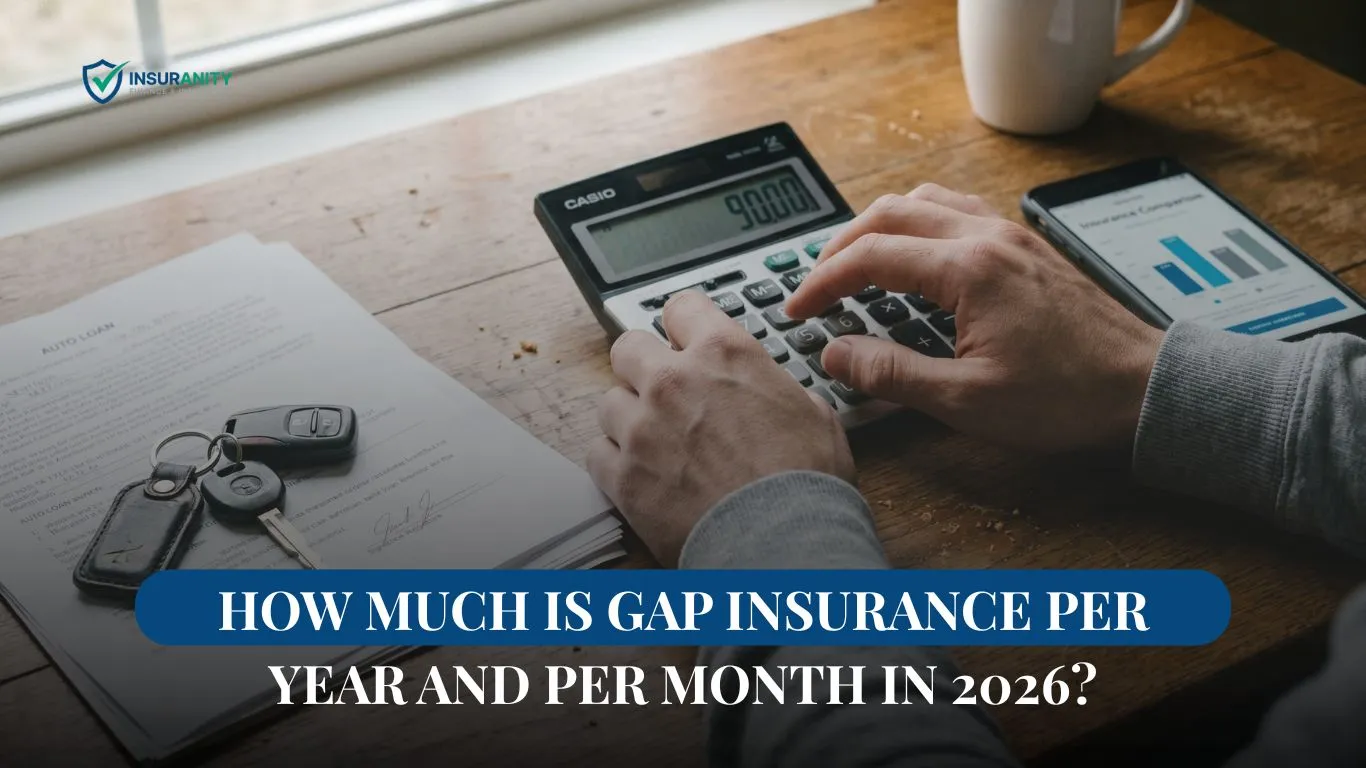
You drove your brand-new SUV off the lot last Tuesday. By Friday, a delivery van ran a red light and totaled it. Your insurance company sends a check for $26,400. Your loan balance? $32,100. Suddenly, you owe $5,700 on a car sitting in a junkyard. This is the exact financial trap that gap insurance was built to prevent, and it is also the reason millions of drivers ask the same question every year: how much is gap insurance, and is it actually worth what it costs?
The short answer is that gap coverage is one of the cheapest forms of car protection you can buy if you shop in the right place. The long answer involves dealership markups, state-by-state pricing differences, refund rules most drivers never hear about, and a few traps that can quietly cost you hundreds of extra dollars. Let’s break it all down in plain English.
The Quick Answer: What Gap Insurance Actually Costs in 2026
If you only have thirty seconds, here is what you need to know about how much is gap insurance costs in 2026:
| Where You Buy It | Typical Cost | Payment Style |
|---|---|---|
| Your existing auto insurer | $20 to $100 per year | Added to monthly premium |
| Standalone insurance company | $150 to $350 (full term) | One-time fee |
| Credit union or bank | $200 to $400 | Financed the car |
| Car dealership | $400 to $1,000+ | Financed with the car |
The national average sits at roughly $7.50 per month or $90 per year when you bundle gap coverage with your existing auto policy. That is the cheapest path for most people, and it is the answer most insurance experts will give you when you ask how much is gap insurance a month.
Now let’s get into the details that actually matter for your wallet.
What Gap Insurance Really Pays For
Gap insurance, sometimes called Guaranteed Asset Protection, covers the difference between what your car is worth on the day it gets totaled and what you still owe the bank. New cars lose around 20 percent of their value in the first twelve months, but auto loans don’t shrink that fast. That mismatch creates the “gap,” and that is exactly what this coverage was designed to close.
Picture Maria from Phoenix. She bought a $34,000 sedan with $2,000 down on a 72-month loan. Eight months later, a flash flood swept through her parking garage, and her car was declared a total loss. Her auto insurer paid out $24,800 (the actual cash value), but her loan payoff was $30,200. Without gap coverage, she would have written a check for $5,400 to settle a loan on a car she could no longer drive. Her gap policy, which cost her $6 a month, covered every penny of that shortfall.
This is why the question of how much is gap coverage insurance matters so much. The premiums are tiny compared to the protection.
How Much Is Gap Insurance Per Month From Major Insurers
Monthly pricing is where most people start their research because it is easier to compare against their other bills. Based on industry data and rate comparisons across major U.S. insurers, here is what you can expect to pay:
- Progressive: around $4 per month
- State Farm: around $4 per month
- Auto-Owners: around $5 per month
- Travelers: around $3 per month in most states
- Erie: up to $20 per month
- Allstate: around $5 to $10 per month (must be added at financing)
So when someone asks how much is gap insurance per month, the honest answer is that it usually lands between $2 and $20, with most drivers paying closer to $5 to $7. Younger drivers, expensive vehicles, and high-risk states push that number up. How much is gap insurance monthly also depends on your overall premium because most carriers calculate it as roughly 5 to 6 percent of your collision and comprehensive cost.
Gap Insurance Costs by State: Texas, Florida, and California
Where you live changes the math more than most drivers realize.

How Much Is Gap Insurance in Texas
Texas drivers tend to get one of the better deals in the country. How much is gap insurance in Texas typically averages around $69 per year, or roughly $5.75 per month, when added to a standard auto policy. State law requires insurers to offer loan or lease payoff coverage as an optional endorsement, which has kept pricing competitive. Houston, Dallas, and Austin drivers usually see rates between $5 and $8 per month.
How Much Is Gap Insurance in Florida
Florida is a different story. Hurricane risk, high theft rates, and elevated vehicle values push premiums upward. How much is gap insurance in Florida generally falls between $90 and $130 per year, or about $8 to $11 per month. Miami and Tampa drivers often pay at the high end of that range due to flood and theft claims.
How Much Is Gap Insurance in California
California sits even higher because of mandated coverage requirements and dense urban traffic. How much is gap insurance in California is around $110 to $145 annually, which translates to about $9 to $12 per month. Los Angeles and the Bay Area come in at the top, while inland regions like Fresno and Bakersfield trend lower.
If your state is not listed, here is a quick rule of thumb: take your collision and comprehensive premium, multiply by 0.06, and you’ll land within a few dollars of your annual gap cost.
How Much Is Gap Insurance Through Dealership? (The Expensive Path)

Now we have to talk about the most expensive way to buy this coverage. How much is gap insurance through dealership financing? Brace yourself: usually $400 to $1,000, and sometimes as high as $1,500 for luxury vehicles or long loan terms.
Here is what makes the dealership option painful. The fee is not paid up front. It gets rolled into your auto loan, which means you pay interest on it for the entire loan term. Take a $700 dealership gap policy on a 60-month loan at 7 percent APR. By the time you finish paying, that $700 has actually cost you closer to $830.
I once spoke with a Kansas City truck buyer who didn’t notice the gap charge on his contract until six months in. He had paid $895 for coverage that his regular insurer would have provided for $72 a year. Over the life of his loan, the dealership version cost him roughly eleven times more.
You may also want to read our breakdown of car insurance for leased vehicles if you’re financing or leasing, because lease agreements often bundle gap coverage in ways most drivers don’t understand.
How Much Is Gap Insurance on a New Car vs. a Used Car
The new vs. used distinction matters more than most buyers expect.
How much is gap insurance on a new car typically runs $20 to $40 per year through your auto insurer because new vehicles depreciate the fastest. The “gap” is widest in the first 18 months of ownership, which is when the coverage earns its keep.
How much is gap insurance on a used car is a bit different. Some insurers won’t even sell gap coverage on vehicles older than three years or with more than 30,000 miles. When they do offer it, expect to pay $30 to $60 per year. Used vehicles depreciate more slowly in absolute dollars, so the gap is usually smaller, but the coverage still makes sense if you put little down or rolled over negative equity from a previous loan.
When asking how much is gap insurance on a car, the right answer depends heavily on the loan-to-value ratio. If you financed 90 percent or more of the purchase price, the gap is almost always worth it. If you put 25 percent down on a vehicle that holds value well, you can probably skip it. The same logic applies to how much is gap insurance for a car in any age bracket: the more upside-down you are on the loan, the more this coverage protects you.
How Much Is Gap Insurance Refund? Understanding the Money Back
This is the part competitors barely mention, and it is the one that quietly costs drivers the most money.
When you pay off your loan early, sell the vehicle, or refinance, you are entitled to a refund of the unused portion of your gap premium. How much is gap insurance refund depends on three things:
- How much you originally paid for the policy
- How many months have you had it active out of the total term
- The refund formula your provider uses (pro-rata or rule of 78)
Here is the simple math. If you paid $700 for a 60-month gap policy at the dealership and you pay off the loan after 24 months, you have 36 months of unused coverage. Under a pro-rata refund, you would get back roughly $420. How much is a gap insurance refund can therefore, hundreds of dollars, but you have to actually request it. Dealerships do not call you up to send the money.
Step-by-step process to claim your refund:
- Locate your original gap insurance contract or addendum
- Calculate the months remaining on your original term
- Contact the issuer (lender, dealer, or insurer) in writing
- Submit proof of loan payoff or vehicle sale
- Request the refund formula in writing before signing anything
- Follow up after 30 days if no check arrives
If you want a deeper look at how refunds and policy changes work across coverage types, our guide on whether you can cancel health insurance at any time walks through similar refund mechanics that apply across the insurance industry.
A Realistic Cost Comparison: Same Driver, Three Different Sources
Let me walk you through a real comparison. Take a 35-year-old driver in Atlanta financing a $32,000 SUV on a 60-month loan.
| Source | Total Cost | True Cost After Interest |
|---|---|---|
| Auto insurer (added to policy) | $90/year × 5 years = $450 | $450 |
| Credit union (rolled into loan) | $300 flat | $354 (with 6.5% APR interest) |
| Dealership (financed) | $750 flat | $885 (with 6.5% APR interest) |
Same protection, three very different outcomes. The auto insurer route saves this driver about $435 over the life of the loan compared to the dealership.
If your own loan involves a vehicle you don’t fully own outright, this guide on insuring a vehicle not in your name is worth bookmarking before you set up coverage.
Factors That Push Your Gap Insurance Cost Up or Down
Several variables shape what you’ll actually pay:
- Vehicle make, model, and depreciation rate. Luxury cars and EVs lose value faster, which raises premiums.
- Loan term length. A 72 or 84-month loan means a longer gap window, so insurers charge more.
- Down payment percentage. Less than 20 percent down equals higher risk and higher premiums.
- Driver age and history. Drivers under 25 typically pay double what 40-year-olds pay.
- Credit score. A weak credit profile bumps up your rate, sometimes by 30 percent or more.
- ZIP code. Urban areas with higher theft rates cost more than rural counties.
The Insurance Information Institute, an independent industry research nonprofit, publishes annual data confirming these factors drive most of the price variation across the country.
Step-by-Step Guide: How to Buy Gap Insurance the Smart Way
Here is the simple checklist most drivers should follow:

- Call your existing auto insurer first. Ask them for a quote on adding gap coverage to your current policy.
- Get a quote from your credit union or bank if you’re financing through one.
- Ask the dealership for their flat-rate price, but treat it as your last resort.
- Compare the three quotes side by side, including any interest you’d pay if the cost is rolled into a loan.
- Check whether your lease already includes gap coverage (most leases do, and double-paying is wasted money).
- Confirm the refund policy in writing before you sign.
- Set a calendar reminder to cancel once your loan balance falls below your car’s value.
Drivers who handle their own household insurance shopping often find that this kind of comparison work pays for itself many times over. Our piece on what makes up a health insurance premium uses the same comparison logic for medical coverage.
When You Probably Don’t Need Gap Insurance
Not every driver needs this coverage. You can skip it if:
- You paid cash or put more than 25 percent down
- Your loan term is 36 months or shorter
- You drive a vehicle with strong resale value (some Toyotas, Hondas, and trucks hold value well)
- You owe less than the car is currently worth
- You already have new car replacement coverage on your policy
If you’re managing a small business with company vehicles, you may also want to look at how commercial property insurance and commercial umbrella coverage interact with gap protection on financed business assets, since the calculations work differently for commercial fleets.
What Most Drivers Get Wrong About Gap Insurance
Three myths cost American drivers millions every year.
Myth one: Gap insurance pays for repairs. It does not. It only kicks in when your vehicle is declared a total loss or stolen and unrecovered. Routine accidents go through your collision coverage.
Myth two: Gap insurance is required by law. No state requires it. Some lenders and lease agreements demand it, but the government does not.
Myth three: All gap policies are the same. They are not. Some pay your deductible, some don’t. Some cover negative equity rolled in from previous loans, others exclude it entirely. Read the fine print.
For drivers who want to protect themselves from broader vehicle-related financial risks, our guide on bond and insurance for small businesses covers similar protection structures for business vehicle fleets and equipment loans.
FAQs
Does gap insurance cover my deductible if my car is totaled?
It depends on the policy. Some gap insurance plans pay your deductible (usually up to $1,000), while others specifically exclude it. The dealership versions and standalone gap policies are more likely to cover the deductible than basic add-ons through your auto insurer. Always read the contract before signing, and ask the agent directly: "Does this policy include deductible reimbursement?" If you have a $1,000 deductible and your gap policy doesn't cover it, you'll still owe that amount out of pocket even after a total loss claim is settled.
What happens to my gap insurance if I trade in my car or refinance the loan?
Your gap policy ends the moment you trade in the vehicle, sell it, refinance the loan, or pay it off early. Once the original loan is gone, the coverage no longer applies because there's nothing left to "gap." However, you're entitled to a refund of the unused portion. Many drivers don't realize this and leave $200 to $500 sitting on the table. Contact your gap provider in writing within 60 days of the loan change, submit proof of payoff or trade-in, and request a pro-rata refund of the remaining premium.
Will gap insurance pay off my loan if my car is repossessed or I stop making payments?
No, gap insurance does not cover repossession, voluntary surrender, or missed payments. It only pays out when your vehicle is declared a total loss due to a covered event (accident, theft, fire, flood, vandalism, or natural disaster) and your auto insurer issues a settlement. If you fall behind on payments and the lender takes the car back, you're still responsible for any deficiency balance. Gap insurance is designed for accidents and theft, not for financial hardship situations. For payment trouble, you'll need to negotiate directly with your lender.
Is gap insurance the same thing as new car replacement coverage?
No, these are two different products that often get confused. Gap insurance pays the difference between what your car is worth (actual cash value) and what you still owe on the loan. New car replacement coverage actually replaces your totaled vehicle with a brand-new model of the same make and trim, regardless of depreciation. New car replacement is more expensive, usually only available on vehicles less than two years old, and typically not needed if you already have gap coverage. Most drivers benefit more from gap insurance because it's cheaper and works for both new and slightly used financed vehicles.
Final Thoughts on Gap Insurance Pricing in 2026
The question of how much is gap insurance costs does not have a single number answer, but the pattern is consistent: cheap if you buy it from your auto insurer, expensive if you buy it from the dealer, and somewhere in the middle if you go through a credit union. The national sweet spot is around $5 to $8 per month for most drivers, and that small premium can save you thousands if your car is ever totaled while you still owe money on it.
If you take only one thing from this guide, let it be this: never sign the dealership gap insurance contract on the same day you sign the loan papers without first calling your auto insurer for a comparison quote. That single phone call is worth, on average, $400 to $700 in savings.
For drivers comparing other auto-related protection products, our breakdown of whether life insurance is worth it uses similar cost-vs-value reasoning that applies just as well to gap coverage decisions.