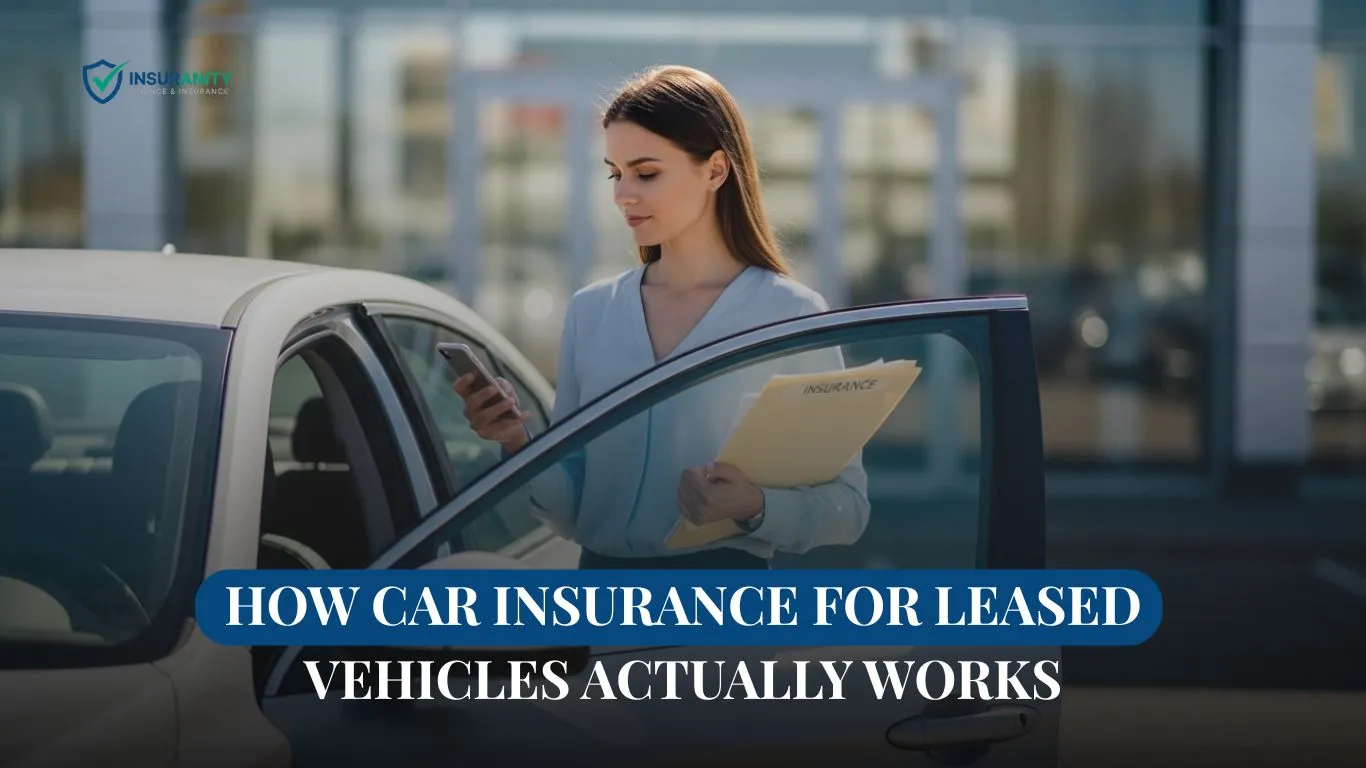
Picture this: You just signed a shiny new lease agreement, drove off the dealership lot feeling great, and then someone rear-ends you at a red light two weeks later. You file a claim, and your insurance company pays out the car’s current value. But here’s the problem nobody warned you about: the car is now worth $3,000 less than what you still owe the dealer. That gap? It comes straight out of your pocket.
This is exactly why car insurance for leased vehicles works very differently from regular car insurance. And most people find this out the hard way.
Whether you are leasing your first car or your fifth, this guide breaks down everything in plain, simple language, no confusing insurance talk, no hidden fine print surprises. By the time you finish reading, you will know exactly what coverage you need, why you need it, and how to avoid overpaying for it.
Why Leased Cars Need Different Insurance
When you lease a car, you do not own it. The leasing company or dealership does. You are essentially paying to drive their car for a set period, usually two to four years.
Because of this, the leasing company has a financial interest in that vehicle. If it gets damaged, stolen, or totaled, they need to be sure there is enough money to cover it. That is why car insurance for leased vehicles comes with stricter requirements than insurance for a car you actually own.
Think of it this way: If you borrow a friend’s laptop and accidentally drop it, they would expect you to cover the full repair cost, not just hand them a few dollars. The leasing company thinks the same way.
So what does this mean for you? You will likely be required to carry more coverage than your state’s basic minimum requires. And that higher coverage comes at a higher monthly cost.
The 4 Key Coverages Required for a Leased Car
Understanding the required coverages is the first step to making smart decisions. Here is what car insurance for leased vehicles almost always includes:

1. Liability Coverage (Higher Than State Minimums)
Every state requires some level of liability insurance. But most leasing companies require limits well above those minimums. While a state might only ask for $25,000 per person in bodily injury coverage, your lease agreement may demand $100,000 per person and $300,000 per accident, often written as 100/300/50.
Liability coverage pays for injuries and property damage you cause to other people. It does not cover your own vehicle.
2. Collision Coverage
Collision coverage pays for damage to your leased car when it hits another vehicle or object, regardless of who caused the accident. This coverage is often optional on cars you own outright, but it is required on leased vehicles.
The reason is simple: the leasing company owns the car and wants to make sure it gets repaired no matter what.
Your lease agreement may also cap your deductible. The amount you pay out of pocket before insurance kicks in. Many lessors require deductibles of no more than $500 to $1,000.
3. Comprehensive Coverage
Comprehensive coverage takes care of damage that has nothing to do with a collision. Think fire, flooding, hail, theft, vandalism, or even a deer jumping in front of your car.
Again, this coverage is required for car insurance for leased vehicles because the leasing company needs to know their asset is protected from all kinds of damage, not just accidents.
4. Gap Insurance
This one is the most misunderstood and the most important.

New cars lose value fast. The moment you drive off the lot, your leased car can drop 15% to 20% in value. If your car gets totaled or stolen, your standard auto insurance policy pays only the car’s current market value, not what you still owe on the lease.
That difference is called the “gap.” And without gap coverage, you pay it yourself.
Example: Your leased car is stolen. The car is currently worth $22,000. But you still owe $27,000 on the lease. Your regular insurance pays the $22,000. You owe the remaining $5,000 out of pocket, unless you have gap insurance.
Gap insurance covers that $5,000. That is why it is considered essential for car insurance for leased vehicles.
Leased vs. Financed vs. Owned: A Quick Comparison
This table makes it easy to see what changes based on how you got your car:
| Coverage Type | Leased Car | Financed Car | Car You Own |
|---|---|---|---|
| Liability | Required (higher limits) | Required (state minimum+) | Required (state minimum) |
| Collision | Required | Usually required | Optional |
| Comprehensive | Required | Usually required | Optional |
| Gap Insurance | Usually required | Recommended | Not needed |
| Deductible limits | Often capped ($500–$1,000) | Flexible | Flexible |
As you can see, leasing comes with the strictest coverage requirements of all three. That is simply because the leasing company is protecting something they still own.
Who Pays the Insurance on a Leased Car?
This is a question many first-time lessees ask, and the answer might surprise you.
You do. Even though the leasing company owns the car, you are fully responsible for purchasing and paying for the insurance policy. The leasing company will be listed on your policy as an “additional insured” and “loss payee.” This means if a claim is paid out, the money goes to them first since it is their vehicle.
So before you drive that leased car home, your insurance must already be active and meet all of the leasing company’s requirements. They will ask for proof of insurance before handing over the keys.
How Much Does Car Insurance For Leased Vehicles Cost?
Car insurance for leased vehicles typically costs more than coverage for owned vehicles. Here is why:
- You are required to carry full coverage (not just liability)
- Higher liability limits mean higher premiums
- Gap insurance adds to the total cost
- The car is newer and more valuable, which raises the insurance rate
On average, full coverage for a leased car in the US costs between $1,100 and $1,700 per year, depending on the car model, your location, your driving record, and the specific leasing company requirements.
However, there is good news: you do not have to overpay. Here is how to keep costs manageable.
Step-by-Step Guide: Getting the Right Coverage for Your Leased Car
Follow these steps before you sign your lease agreement or pick up your car:
Step 1: Read Your Lease Agreement First
Before shopping for insurance, read through your lease agreement carefully. Look for the required liability limits, maximum deductible amounts, and whether gap insurance is already included in your lease payments.
Step 2: Contact Your Current Insurer
If you already have auto insurance coverage, call your provider and explain that you are leasing a vehicle. Ask what it will cost to add the required coverages to your existing policy.
Step 3: Get at Least Three Quotes
Do not go with the first quote you receive. Get at least three quotes from different providers. Rates vary significantly from one company to another for the same coverage.
Step 4: Check Where to Buy Gap Insurance
Here is a money-saving tip most people miss: Gap insurance purchased through a dealership can cost $500 to $700 over the life of a lease. The same coverage through your auto insurer typically runs $20 to $60 per year. Always check with your insurer first.
Step 5: Confirm the Leasing Company is Listed Correctly
Make sure the leasing company is listed as an “additional insured” and “loss payee” on your policy. Without this, your lease agreement may technically be in violation.
Step 6: Time Your Coverage Start Date
Make sure your insurance is active on the exact day you pick up the car, not a day before (wasted money) or a day after (a lease violation). Most insurers allow you to set a future start date.
Step 7: Set a Reminder for Lease End
About 30 days before your lease ends, contact your insurer. Once you return the car, you can lower your coverage limits if you are not leasing or financing another vehicle.
Common Mistakes People Make With Leased Car Insurance
Even people who have leased cars before make these mistakes:
Buying gap insurance from the dealership without checking your insurer first. This can easily cost you $300 to $500 more over a three-year lease.
Assuming the state minimum coverage is enough. It is not. Leasing companies require higher limits, and showing up with the wrong coverage can result in forced insurance, which costs two to three times more than what you would have paid.
Not reading the deductible requirements. Some lessors will not accept policies with deductibles above $1,000. If yours is set at $2,000, your lease may be in violation.
Forgetting to update the policy after returning the car. You should not be paying for full coverage on a car you no longer drive.
Does the Leasing Company’s Coverage Protect You?
A common misunderstanding is that the leasing company’s insurance covers you. It does not.
The leasing company may have its own policy on the vehicle, but that policy protects them, not you. You are still fully responsible for carrying your own insurance policy that meets their stated requirements.
This is one of those things that catches people completely off guard when they file a claim. Always treat the leasing company’s requirements as the minimum floor, not the ceiling.
What Happens If You Drive Without Proper Coverage?
If you skip required coverage or carry the wrong limits, the consequences can be serious:
- The leasing company may purchase force-placed insurance on your behalf and charge you at 2 to 3 times the normal rate
- You could violate your lease agreement, which may allow the leasing company to repossess the vehicle
- If you are in an accident without sufficient coverage, you are personally responsible for the difference between what your insurance pays and what you actually owe
This is not a situation anyone wants to be in, especially when the fix is simply calling your insurer and adjusting your policy before you drive.
How to Save Money on Car Insurance For Leased Vehicles
Yes, car insurance for leased vehicles costs more. But that does not mean you cannot reduce what you pay. Here are proven ways to lower your premium:

Bundle your policies
If you combine your auto and renters or homeowners insurance under one provider, you can usually get a meaningful discount on both.
Improve your credit score
In most states, your credit score affects your insurance rate. A better score means a lower premium. States like California, Hawaii, and Massachusetts do not allow this practice, so rates there may be more uniform.
Take a defensive driving course
Many insurers offer discounts for completing a certified driving course. It is often an easy online class that takes just a few hours.
Ask about safety feature discounts
Newer leased cars often come equipped with anti-lock brakes, lane assist, and anti-theft technology. Each of these can qualify you for discounts.
Shop around every year
Even if you are mid-lease, your insurer can usually adjust your policy. If you find a significantly lower rate elsewhere, switching is often worth the effort.
The “Additional Insured” Rule Explained Simply
When you take out car insurance for leased vehicles, your policy will list the leasing company as an “additional insured” and “loss payee.”
Here is what that means in simple terms:
- An additional insured means the leasing company is also protected by your policy
- Loss payee means any insurance money paid out goes directly to them first, since they own the car
This is not something you negotiate. It is a standard requirement for any leased vehicle. Your insurer knows how to set this up. Just give them the leasing company’s full name and address when you call.
Understanding Depreciation and Why It Matters for Leased Cars
One thing that is rarely explained clearly is how fast cars lose value, and why it matters so much when leasing.
A brand-new car can lose 15% to 20% of its value the moment it leaves the dealership. After one year, it may have lost 25% to 30% of its original price. This rapid depreciation is exactly why gap insurance exists.
When your car is totaled or stolen, insurance companies calculate what the car is worth right now, not what you paid for it. If that amount is less than your remaining lease balance, you are responsible for the difference. Gap insurance closes that financial hole, so you are not stuck paying for a car you no longer have.
This is the single most important reason car insurance for leased vehicles works differently than standard auto coverage.
FAQs
Can I switch my car insurance for leased vehicles to a different provider in the middle of my lease?
Yes, you can switch insurance providers while your lease is still active. There is no rule that locks you into the same insurer for the entire lease term. However, before you switch, make sure your new policy meets all of your leasing company's coverage requirements. Including the required liability limits, deductible caps, and gap insurance. You also need to make sure there is zero gap in coverage between your old policy ending and the new one starting, even for a single day. After switching, update your leasing company with proof of the new policy right away, since they are listed as an additional insured and loss payee on your coverage.
Does a minor accident or fender bender affect my leased vehicle's return inspection?
Yes, it can. When you return a leased vehicle at the end of your lease term, the leasing company performs a detailed inspection. If the car shows damage beyond what is considered normal wear and tear, including repairs that were not done correctly or not completed using approved parts, you may be charged excess wear and tear fees. Even if your insurance paid for the repairs, a poorly repaired vehicle can still cost you money at lease return. To protect yourself, always use a repair shop that uses OEM parts, keep all repair documentation, and do a pre-return inspection yourself so there are no surprises.
If my leased car is totaled, does my lease automatically end?
Not exactly. When a leased car is declared a total loss, your insurance company pays the leasing company the car's actual cash value. However, the lease contract itself does not automatically disappear. You are still responsible for any remaining balance between what insurance paid and what you owe on the lease, unless you have gap insurance. Some lease agreements also include early termination fees, remaining monthly payments, or other contractual obligations even after a total loss. This is one of the most overlooked financial risks with leasing, and it is exactly why gap insurance is so strongly recommended for every leased vehicle.
Does my car insurance for leased vehicles cover a rental car while mine is being repaired?
Not automatically. Standard collision and comprehensive coverage do not include rental car reimbursement unless you specifically add it to your policy. If your leased vehicle is being repaired after a covered accident, you may be without a car for days or even weeks, and that cost comes out of your pocket unless you have rental reimbursement coverage. Many leasing companies do not provide a loaner vehicle during repairs, so this add-on is worth considering when building your policy. It typically costs just a few dollars a month and can save you a significant amount if your car is in the shop for an extended period.
A Final Word From Insuranity
At Insuranity, we believe that understanding your coverage should never feel like reading a legal textbook. Car insurance for leased vehicles has more moving parts than standard auto insurance, but once you understand the four key coverages, the cost factors, and the gap insurance piece, the whole picture becomes clear.
The most important thing to remember: read your lease agreement before you shop for insurance, compare gap insurance costs between your insurer and the dealership, and make sure your coverage is active and confirmed before you drive off the lot.
You are driving someone else’s car. Protect yourself and protect your wallet by getting the right car insurance for leased vehicles from the start.
For a broader look at how different types of insurance policies work together to protect your finances, the Insurance Information Institute is a trusted, nonprofit resource worth bookmarking.
This article is for educational and informational purposes only. Insuranity is an insurance education and comparison resource. We do not sell or underwrite insurance policies.