
Picture this: Marcus has been running his electrical contracting business for six years. Steady clients, a solid crew, and a reputation built job by job. Then one afternoon, a homeowner trips over a cable his team left on the floor, breaks her wrist, and files a lawsuit the next week. The legal bill alone nearly wipes out everything Marcus spent six years building.
That single incident is why electrical contractor public liability insurance exists. Not as a technicality. Not as a box to check before bidding on a job. As a real financial buffer between you and the kind of claim that can end a business overnight.
This article breaks down exactly how electrical contractor public liability insurance works, what it covers, what it does not cover, how much it actually costs, and the steps you need to follow to get the right policy for your specific situation.
What Is Electrical Contractor Public Liability Insurance?
Electrical contractor public liability insurance covers claims made against you by people who are not you or your employees. That includes customers, property owners, passersby, and anyone else your work could affect.
When something goes wrong during a job, say, a client’s hardwood floor gets scorched because of a wiring spark, or a visitor to the job site slips on a wet surface, the affected person can file a compensation claim. Without coverage, that compensation comes out of your own pocket. With electrical contractor public liability insurance, your insurer steps in to handle the costs.
This coverage is sometimes called general liability insurance in the US. “Public liability” is a more common term around the world, but both terms mean the same thing: protection for bodily injury and property damage caused by your business operations to other people.
Why Electrical Contractors Face Unique Risks
Electrical work is not like painting a room or laying tile. The materials involved, high-voltage wiring, circuit panels, and energized systems, carry real hazards that other trades simply do not deal with at the same level.
According to the Electrical Safety Foundation International (ESFI), electrical fires account for roughly 51,000 home structure fires annually in the US. When electrical work is involved, proving or disproving fault becomes a legal process. That process costs money whether you are found liable or not.
Beyond fire risks, electrical contractors regularly work in occupied homes, commercial spaces, and active construction sites. Any one of those environments can produce a slip, a fall, a damaged appliance, or a structural issue tied back to electrical work. Electrical contractor public liability insurance is specifically suited to address these scenarios because it covers the types of incidents most likely to occur in this trade.
Additionally, most states require proof of liability coverage before an electrical contractor can obtain or renew a license. Clients, general contractors, and government agencies commonly ask for a certificate of insurance before any work begins. Without it, you cannot bid on many jobs at all.
What Electrical Contractor Public Liability Insurance Covers
Here is what a standard electrical contractor public liability insurance policy typically pays for:
Third-Party Bodily Injury
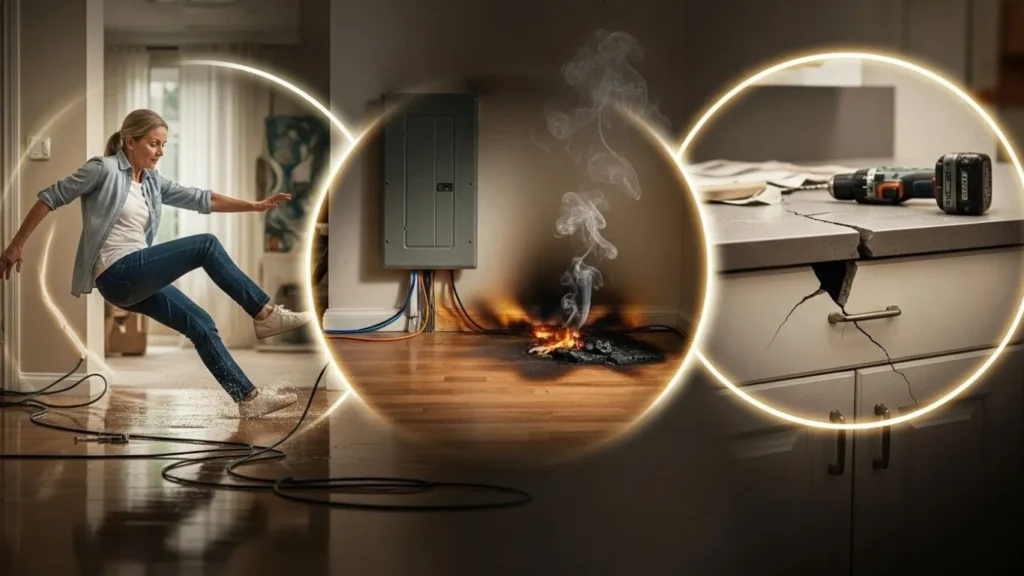
If someone other than your employee is physically hurt because of your work or your presence on a job site, this coverage handles their medical costs, emergency services, and any legal fees if they decide to sue. The homeowner who trips over your cable. The customer who walks into a poorly marked work zone. The neighbor affected by smoke from an electrical incident that your crew caused. All of these fall under bodily injury claims.
Third-Party Property Damage
If you or your crew damages someone else’s property while working, the policy covers the cost of repair or replacement. This is more common than people expect. Drilling into a wall and severing a plumbing line. Accidentally cracking a countertop. Burning a carpet during panel installation. Electrical contractor public liability insurance is what pays to fix it without the repair cost coming out of your business account.
Legal Defense Costs
Even if a claim against you turns out to be false or exaggerated, defending yourself in court is expensive. Attorney fees, court filing costs, and expert witnesses add up fast. Most electrical contractor public liability insurance policies cover these legal defense costs as part of the coverage, separate from the payout limit.
Completed Operations Coverage
This one is easy to overlook. Completed operations coverage protects you after a job is finished. If a client discovers months later that your wiring caused a fire or equipment failure, and they can trace it back to your work, completed operations coverage handles that claim. It is included in most standard general liability policies for contractors.
Personal and Advertising Injury
Some policies also cover claims of defamation, copyright infringement in your advertising, or false arrest. This is less common for electrical contractors to trigger, but it is part of the standard coverage package.
What It Does Not Cover
Electrical contractor public liability insurance is not a catch-all policy. Knowing the gaps matters just as much as knowing what is included.
Your own injuries are not covered. If you or an employee is hurt on the job, that is a workers’ compensation claim. For sole proprietors, workers’ compensation insurance for sole proprietors is a separate policy worth understanding before you assume you are protected.
Your tools and equipment are not covered by public liability policies. A separate inland marine or tools and equipment policy handles theft or damage to your gear. Business personal property insurance covers the equipment you own and use on the job.
Professional mistakes and faulty workmanship are generally excluded from standard public liability policies. If a client claims your installation was done incorrectly and wants the work redone, that falls under professional liability or errors and omissions coverage, not public liability.
Vehicle accidents are not covered. Your work trucks need a commercial vehicle insurance policy separate from your liability coverage.
Intentional damage is never covered. If you or someone on your crew deliberately causes harm, no insurer will pay that claim.
How Much Does Electrical Contractor Public Liability Insurance Cost?
Cost depends on several factors specific to your business. The size of your operation, the states you work in, your annual revenue, your claims history, and whether you take on residential or commercial work all affect what you pay.

That said, here is a general comparison based on common policy levels:
| Coverage Level | Per Occurrence Limit | General Aggregate | Estimated Annual Cost |
|---|---|---|---|
| Basic | $300,000 | $600,000 | $400 – $700 |
| Standard | $1,000,000 | $2,000,000 | $700 – $1,500 |
| High-Risk / Commercial | $2,000,000 | $4,000,000 | $1,500 – $3,500+ |
Electrical contractors typically pay more than other trades because the risk of fire damage, high-value property damage, and serious injury is statistically higher. Premiums are usually higher in states like California, New York, and Florida because they have more claims and stricter rules.
Putting things together is a good way to save money. A Business Owner’s Policy (BOP) combines general liability and commercial property coverage into one package, which is usually cheaper than buying them separately. If you want to understand how bundled coverage compares to standalone policies, the bond and insurance guide for small businesses explains the tradeoffs clearly.
For broader coverage that goes beyond what electrical contractor public liability insurance provides, some larger electrical contractors also carry an umbrella policy. Commercial umbrella insurance kicks in when your primary policy limits are exhausted by a large claim, which matters more the more complex and high-value your projects become.
How to Get Electrical Contractor Public Liability Insurance: A Step-by-Step Guide
Getting insured is not complicated, but rushing through it can leave you with gaps. Here is how to do it properly.
Step 1: Find out what your state needs.
Each state has its own minimum coverage requirements for getting an electrical contractor license. Some require as little as $300,000 in general liability. Others want $1 million or more. Before you shop for quotes, look up your state’s electrical licensing board requirements or contact them directly. This tells you the floor, not the ceiling.
Step 2: Calculate Your Revenue and Payroll
Most insurers base your premium on your gross annual revenue and, if you have employees, your total payroll. Have these numbers ready before requesting quotes. Underestimating either one can lead to coverage disputes if a claim arises.
Step 3: Decide on Your Coverage Limits
Your state minimum is a starting point, not a recommendation. A single serious claim involving commercial property damage or a severe injury can easily exceed $300,000. Most working electrical contractors choose at least $1 million per occurrence and $2 million aggregate as a baseline. If you work on larger commercial projects, higher limits make financial sense.
Step 4: Gather Multiple Quotes
Do not buy from the first provider you find. Get quotes from at least three to five insurance companies that specialize in contractor coverage. Don’t just look at the price; also look at the terms of coverage, what isn’t covered, and how claims are handled. A cheaper policy with a slower or stricter claims process might end up costing you more when you need it most.
Step 5: Review Your Policy for Add-Ons
Once you have a base policy, consider what else your work requires. Completed operations coverage, products liability, and blanket additional insured endorsements are commonly needed by electrical contractors. If a general contractor or property owner requires you to name them as an additional insured, that is a policy endorsement, and not all base policies include it automatically.
Step 6: Get Your Certificate of Insurance
After you buy your policy, your insurer will issue a certificate of insurance (COI). This is the document clients and licensing boards ask for. Keep a digital copy on your phone and in your work truck. You will need it more often than you expect.
Step 7: Review Your Policy Annually
Your business changes. Your coverage should keep up. If you hire more people, take on bigger business jobs, or move to a new state, your current policy might not be enough. Schedule a review every 12 months or any time your business changes significantly.
Do You Need Additional Coverage Alongside Public Liability?
Electrical contractor public liability insurance is the foundation, but it rarely stands alone for a complete protection strategy. Most electrical contractors end up needing several types of coverage working together.
Workers’ compensation is required in most states the moment you hire even one employee. If you are self-employed with no staff, it is still worth understanding whether your state requires it or whether clients will ask for it.
Professional liability (also called errors and omissions) covers claims that your electrical work was done incorrectly, even if no one was physically hurt. A commercial client who says your panel installation caused repeated equipment failures and lost revenue, that is a professional liability claim, not a general liability claim.
Inland marine/tools and equipment coverage protects the physical gear you depend on. Stolen multimeters, damaged wire pullers, or equipment lost in a vehicle break-in are all common scenarios in the trade.
Surety bonds are often required separately from insurance. A contractor license bond guarantees that you will complete a job as promised. It is not insurance. But licensing bodies and some clients require both. Understanding business liability insurance in NJ or your specific state gives you a practical sense of how bonding and liability requirements stack up together.
Real-World Scenarios Where Electrical Contractor Public Liability Insurance Pays Out
Understanding the coverage in abstract terms is useful. Seeing it in action makes it real.

Scenario 1: An electrician finishes rewiring a commercial kitchen. Three weeks later, a grease fire starts, and the owner claims faulty wiring caused it. The investigation does not definitively clear or blame the electrician. The owner sues. Electrical contractor public liability insurance pays for the legal defense and any settlement that is within the policy limits.
Scenario 2: A crew is running conduit through a wall in a retail space. The flooding damages the floor and the inventory. While the store is closed, it files a claim for repairs and lost sales. The public liability insurance for the electrical contractor pays for the repairs to the walls and floors. The business interruption claim depends on the policy’s terms.
Scenario 3: An unlicensed electrical contractor’s subcontractor starts a small fire in a house’s attic. The homeowner names both the subcontractor and the general contractor in their suit. If the electrical contractor’s policy includes a blanket additional insured endorsement covering the general contractor, the policy responds to both parties.
These situations happen regularly in the trade. They are not edge cases.
A Note on Compliance and Licensing
In most US states, electrical contractor public liability insurance is not just good business practice. It is a legal requirement. California, Texas, Florida, and New York are just a few of the states that require licensed electrical contractors to have at least a certain amount of liability insurance. If you don’t have it, you could lose your license, your ability to get permits, and your ability to work on public or commercial projects.
If you are unsure about your state’s specific requirements, consult a licensed insurance agent who specializes in contractor coverage or contact your state’s contractor licensing board directly. The rules vary more than most people expect, and the cost of non-compliance is much higher than the cost of the policy.
Understanding broader liability topics like business liability insurance basics and how commercial property coverage for landlords works can also help if your electrical contracting work involves properties you own or manage.
For professional service claims that go beyond property damage, reading about malpractice insurance costs gives useful context on how professional liability is priced, since the pricing logic is similar to errors and omissions policies for contractors.
FAQs
Can a claim be filed against my electrical contractor public liability insurance even if the job was finished months ago?
Yes. Completed operations coverage, which is included in most standard policies, protects you after a job is done. If a client discovers an issue weeks or months later and can link it to your work, a claim can still be filed. The key factor is whether the damage or injury occurred within your policy period or is covered under your completed operations terms. This is one reason electrical contractors should maintain continuous coverage rather than letting a policy lapse between jobs.
Will my electrical contractor public liability insurance cover a claim if my employee caused the damage?
Yes, in most cases. Your policy covers your business operations, which includes the actions of employees working under your direction. If an employee on your crew accidentally damages a client's property or causes a third-party injury while on the job, your general liability policy responds to that claim. However, if the employee was acting outside the scope of their job duties or caused intentional harm, coverage may be denied.
What happens to my electrical contractor public liability insurance rate after I file a claim?
Filing a claim typically raises your premium at renewal. How much it goes up depends on the size of the claim, the nature of the incident, and your overall claims history. A single small claim may cause a modest increase. Multiple claims or a large payout can significantly raise your rate or, in some cases, lead an insurer to decline renewal. This is why some contractors with minor incidents choose to pay out of pocket rather than file, though that decision depends on the cost involved and your deductible amount.
Is electrical contractor public liability insurance tax deductible?
Yes. In the US, business insurance premiums are generally considered an ordinary and necessary business expense by the IRS, which makes them tax deductible. This applies to electrical contractor public liability insurance as well as other business-related policies like workers' compensation and commercial auto. You deduct the premiums in the tax year they are paid. It is worth confirming the specifics with a tax professional based on your business structure, since deduction rules can vary for sole proprietors, LLCs, and corporations.
The Bottom Line
Electrical contractor public liability insurance is not complicated once you understand what it does. It pays third-party claims. It covers legal defense. It keeps one bad day on a job site from becoming a financial crisis that follows you for years.
Marcus, the electrician from the opening of this article, his story is not unusual. What made the difference for him was that he had a $1 million general liability policy in place before the homeowner tripped. The claim was settled. He stayed in business. His reputation took a small hit, but his savings and his company survived.
That is what this coverage is for.
If you are just starting, a basic policy with $1 million per occurrence is a reasonable starting point. If you are bidding on commercial projects, doing high-voltage work, or managing crews across multiple sites, higher limits and additional endorsements will serve you better. For a broader look at how different insurance types work together for service businesses, the handyman insurance guide covers overlapping coverage concepts in plain language.
The most important thing is to get covered before something happens. Not after.
External reference: For state-by-state electrical contractor licensing and insurance requirements, the National Electrical Contractors Association (NECA) maintains resources for licensed electrical professionals across the US.