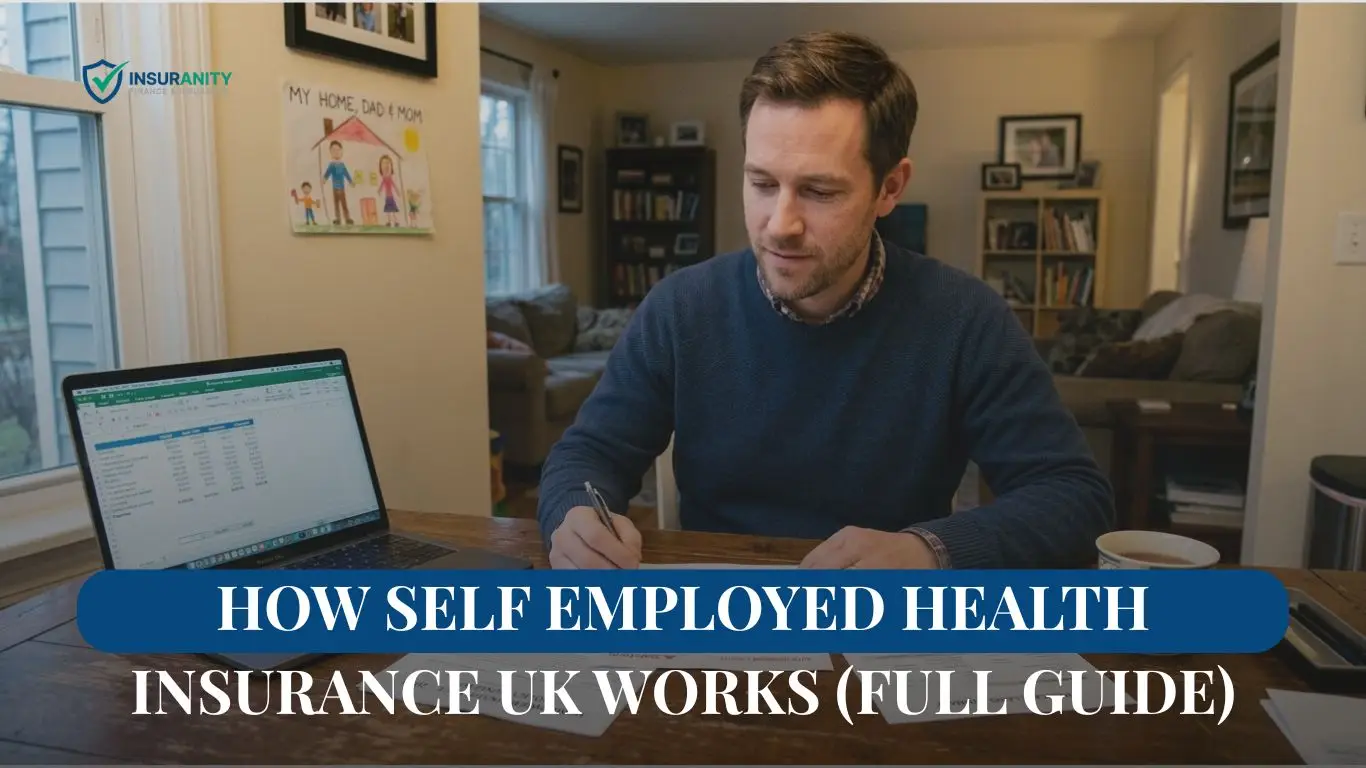
Imagine you are a freelance graphic designer. Things are going well, clients are happy, and the work is steady. Then one morning, you wake up with sharp chest pain. You call the NHS, and the earliest specialist appointment is 14 weeks away. Fourteen weeks. For someone who earns only when they work, that wait could cost thousands in lost income and weeks of anxiety while you wait just to find out what is wrong.
This is the exact reason self employed health insurance UK exists. It is not a luxury product for the wealthy. It is a practical safety net for anyone who works for themselves and knows that their ability to earn is tied directly to their ability to stay healthy.
This guide explains everything how it works, what it covers, what it costs, the tax rules, and how to pick the right plan. No jargon, no fluff.
What Is Self Employed Health Insurance UK, Exactly?
Self employed health insurance UK is a type of private medical insurance (PMI) bought by freelancers, sole traders, contractors, and limited company directors to get fast access to private healthcare when they need it.
The NHS still exists for you. You are not giving that up. Private health insurance sits alongside the NHS as a faster, more flexible option for treatment of new medical conditions.
Think of it this way: the NHS is your safety net for emergencies and serious long-term conditions. Self employed health insurance UK is what you use when you need to see a specialist quickly, get a scan done in days instead of months, or recover from surgery without waiting in a long queue.
There are roughly 4.4 million self-employed workers in the UK. Most of them rely entirely on the NHS. But with waiting lists for non-urgent treatment stretching past three months in many areas, that reliance carries a hidden financial risk that most people never think about until it is too late.
Why the NHS Alone Is Not Always Enough When You Work for Yourself

If you are employed and get sick, life is hard but manageable. Your employer pays you statutory sick pay. HR handles paperwork. You wait, you recover, you return.
When you are self-employed and get sick, there is no sick pay. There is no employer. If you are not working, money stops coming in. Every week you spend waiting for a diagnosis or treatment is a week of income you will never get back.
The financial risk is real. Consider this: if a self-employed web developer earning £4,000 a month needs minor surgery, and the NHS wait is four months, that is potentially £16,000 in lost income not including any business relationships damaged during that time.
This is not about distrust of the NHS. It is about protecting your income and your business when your health is the only thing keeping it running. That distinction matters.
If you are curious whether health insurance is legally required, the answer in the UK is no but the financial case for having it when you are self-employed is very strong.
What Does Self Employed Health Insurance UK Actually Cover?
Coverage varies by policy, but most standard self employed health insurance UK plans include the following core areas:
- Inpatient and Day Patient Treatment This covers you when you need to be admitted to a private hospital, whether overnight or just for the day. It includes the hospital room, nursing care, surgeon fees, and anaesthetist costs.
- Outpatient Consultations and Diagnostics This is one of the most important parts of private cover for self-employed people. It pays for specialist consultations, MRI scans, CT scans, X-rays, and blood tests before and after any treatment. Without outpatient cover, you could still face NHS waiting times for the diagnosis phase, which is often where the longest delays happen.
- Cancer Cover Most UK private medical insurance policies include strong cancer benefits. This typically covers chemotherapy, radiotherapy, targeted drug therapies, and access to treatments that may not be routinely available on the NHS due to cost.
- Mental Health Support Increasingly standard in modern self employed health insurance UK plans. This covers private therapy sessions, psychiatric treatment, and in some cases, access to mental health apps and 24/7 phone support.
- Private GP Access Many policies include virtual GP services with same-day or next-day appointments. This is genuinely one of the most-used benefits by self-employed people getting fast access to a GP without the usual wait.
- Physiotherapy Covered for acute conditions. Useful for the self-employed tradesperson, personal trainer, or anyone whose income depends on physical capability.
What Is Typically Not Covered
Understanding exclusions is just as important as understanding benefits. Standard self employed health insurance UK policies generally do not cover:
- Pre-existing conditions (those you had before the policy started)
- Emergency A&E treatment (that remains with the NHS)
- Chronic or long-term conditions like diabetes or asthma (though complications of these may be covered)
- Cosmetic treatment
- Dental and optical care (unless added as optional extras)
- Pregnancy and routine maternity care
The Two Types of Underwriting Explained Simply
When you apply for self employed health insurance UK, the insurer needs to understand your medical history. This process is called underwriting, and there are two main approaches.
Moratorium Underwriting
This is the simplest option. You do not fill out a detailed health questionnaire upfront. Instead, any condition you have had symptoms or treatment for in the five years before your policy starts is automatically excluded for now. If you go two full years into your policy without any symptoms or treatment for that condition, it may then become covered. Most people choose this route because it is fast and straightforward.
Full Medical Underwriting (FMU)
Here, you declare your complete medical history before the policy starts. The insurer reviews it and gives you a clear list of what is and is not covered. There are no surprises later. This approach takes longer upfront but offers more certainty at claims time.
Neither option is universally better. If you have a complex medical history and want clarity, FMU may suit you better. If your history is relatively clean and you want to start cover quickly, moratorium underwriting is the natural choice.
How Much Does Self Employed Health Insurance UK Cost?
Premiums vary based on several factors:
| Factor | Impact on Premium |
|---|---|
| Age | Older applicants pay more |
| Smoking status | Smokers pay significantly higher premiums |
| Location | London and South East tend to cost more |
| Level of cover | More comprehensive cover costs more |
| Excess chosen | Higher excess = lower monthly premium |
| Hospital list | Access to more hospitals raises costs |
As a rough guide, a healthy non-smoker in their mid-30s choosing a core plan with a £250 excess might pay around £40 to £70 per month. A more comprehensive plan at the same age could reach £100 or more. Costs rise meaningfully as you get older or add optional extras like dental, optical, or worldwide cover.
Choosing a higher excess the amount you pay toward any claim before insurance kicks in is one of the most effective ways to reduce your monthly premium without giving up core protection. An excess of £500 or even £1,000 can cut premiums noticeably, and for minor issues you might self-fund anyway, that trade-off often makes sense.
The Tax Rules: Sole Trader vs Limited Company Director
This is one of the most misunderstood areas of self employed health insurance UK, and getting it wrong can cost you money.
If you are a sole trader or partner:
You pay for private medical insurance out of your post-tax income. HMRC requires that business expenses be “wholly and exclusively” for the purpose of trade. Because your health insurance benefits you personally not just your business it fails that test. You cannot claim it as an allowable business expense. This rule applies even if your primary motivation is getting back to work faster.
If you operate through a limited company:
The rules change considerably. Your limited company is a separate legal entity. When the company pays your private health insurance premiums, it can treat those as a staff welfare expense and deduct them from its taxable profits, reducing its Corporation Tax bill.
However, the insurance is then treated as a Benefit in Kind (BIK) for you personally. You will pay income tax on the value of the premiums at your marginal rate, and the company pays Class 1A National Insurance on the same amount. A P11D form is used to report this to HMRC.
The net result for limited company directors is that, while there is a tax cost, the combined Corporation Tax saving and the practical value of faster healthcare often make it financially worthwhile. Speaking to an accountant about your specific situation is always the right move.
Self Employed Health Insurance UK vs Income Protection: Not the Same Thing
A common point of confusion is the difference between health insurance and income protection insurance. They are related but cover completely different risks.
Private medical insurance pays for private medical treatment
hospital stays, specialist fees, scans, and therapy. It covers the cost of getting you better.
Income protection insurance pays you a monthly income if you are unable to work due to illness or injury. It replaces lost earnings, not medical bills.
For a self-employed person, both can be relevant. A serious illness could trigger both a need for private treatment (health insurance pays) and months of lost income (income protection pays). They are often described as complementary products rather than alternatives.
Many self-employed people start with one and add the other as their income and business stability grows. Understanding both helps you build a financial safety net that genuinely covers your real risks.
This connects closely to the broader question of what insurance sole proprietors actually need to stay protected when working independently.
Step-by-Step: How to Get Self Employed Health Insurance UK
Here is a simple process to follow if you are starting from scratch.
Step 1 Identify your biggest risk
Ask yourself: what would hurt me more waiting three months for treatment, or losing three months of income? That answer shapes which products you prioritize.
Step 2 Decide your budget
Work out what you can comfortably afford each month. Even a basic plan with a high excess is better than no cover at all.
Step 3 Choose your underwriting type
If your health history is complex and you want certainty, choose full medical underwriting. If it is straightforward, moratorium is usually fine.
Step 4 Pick your core cover
At minimum, include inpatient treatment and outpatient diagnostics. Outpatient cover is especially important for the self-employed because diagnosis delays are often the biggest source of lost income.
Step 5 Set your excess
A higher excess reduces your premium. Set it at a level you could genuinely afford to pay if you needed to claim.
Step 6 Choose your hospital list
Plans with access to more private hospitals cost more. If you live in a city with several private hospitals nearby, a broader list may be worth it. If you are in a rural area, a focused local list may be sufficient and cheaper.
Step 7 Apply and get your documents
Once approved, you will receive your policy documents detailing exactly what is and is not covered. Read these carefully before you need to make a claim.
Step 8 Know how to claim
If you need treatment, start by seeing a GP either your NHS GP or the private GP service included in your plan. Ask for an open referral to a specialist. Contact your insurer before booking private appointments to confirm the treatment is covered. Most modern insurers have apps or online portals that make this straightforward.
Does Self Employed Health Insurance UK Cover Pre-Existing Conditions?
This question comes up often, and the honest answer is: usually not immediately, but sometimes eventually.
Under moratorium underwriting, any condition you have had in the five years before your policy starts is excluded. But if you go two continuous years without symptoms or treatment for that condition after your policy begins, it may become eligible for cover. This is called the moratorium period.
Under full medical underwriting, your insurer reviews your history and gives you a clear list of exclusions upfront. Some conditions may be permanently excluded. Others may be covered with a premium loading (higher cost) or a time-limited exclusion.
If you have a pre-existing condition and are worried about coverage, full medical underwriting gives you more certainty. You will know before you sign what is and is not included, rather than finding out at claims time.
Is Self Employed Health Insurance UK Worth It?
The honest answer depends on your situation. Here are the questions that matter most:
- How long could you survive financially without income?
- Is your work physically or mentally demanding?
- Do you have dependents who rely on your earnings?
- How much do NHS waiting times in your area currently affect access to specialists?
For a self-employed person with no financial buffer, a condition requiring several months of treatment or recovery could be devastating. Private medical insurance reduces both the financial and emotional impact of that scenario significantly.
It is also worth considering that having dual health plan options is a legitimate strategy for some people combining NHS access for emergencies with private cover for faster elective and specialist treatment.
Self employed health insurance UK is most clearly worth it if:
- You work in a field where being off work costs you real money quickly
- You would not cope financially with a three to six month income gap
- You have family members who depend on your earnings
- You want faster access to specialists and diagnostics without long waits
It is less pressing if you have significant savings that could fund a long absence, or if your work allows you to take extended time off without serious financial consequences.
Smart Ways to Reduce Your Self Employed Health Insurance UK Premium

Paying for cover does not have to break the bank. Here are practical steps to get good value:
Increase your excess
Choosing a £500 or £1,000 voluntary excess can cut your monthly premium by a meaningful amount. You are essentially self-insuring minor issues and using the policy for significant claims.
Choose a focused hospital list
Selecting a plan that covers a smaller network of hospitals particularly those near where you live is typically cheaper than open access to every private hospital in the country.
Drop optional extras you do not need
Dental, optical, and worldwide travel cover all add to the premium. If you have separate dental insurance or do not travel frequently for work, removing these can save money.
Stay healthy
Some modern plans offer premium discounts or rewards for hitting fitness and activity targets. Regular exercise, tracked through a wearable, can actually reduce what you pay each year.
Review annually
Do not auto-renew without checking alternatives. Premiums can rise at renewal, and the market changes. Reviewing your cover each year is a simple habit that often saves money.
How Self Employed Health Insurance UK Relates to Other Business Insurance
Health insurance is one piece of a broader protection picture for self-employed people. It is worth understanding how it fits alongside other types of cover.
Public liability insurance for contractors protects you if your work causes injury or damage to someone else’s property. Business bonds and insurance help small businesses meet client requirements and protect against specific professional risks. These are about protecting your business from external liability separate from the personal health protection that PMI provides.
Understanding the full picture of what protection you need as a self-employed person is how you build genuine resilience, not just react to problems after they happen.
For those operating as sole proprietors or contractors who also deal with vehicles for work, knowing how to switch car insurance efficiently can be part of keeping overall business protection costs under control.
FAQs
Does private health insurance cover loss of income if I cannot work?
Standard private health insurance usually does not replace lost income. Self-employed workers often combine health insurance with income protection insurance, which pays a monthly amount if illness or injury prevents them from working for a long period.
Is digital GP access included in UK private health insurance plans?
Many modern UK health insurance policies now include 24/7 virtual GP appointments, prescription services, mental health support, and video consultations through mobile apps. These services can help self-employed workers save time and avoid long NHS waiting lists.
Can I pause or change my self-employed health insurance policy if my income changes?
Most UK insurers allow policyholders to adjust coverage levels, increase excess amounts, or remove optional add-ons if business income changes. Some providers also offer flexible monthly payment options for freelancers and sole traders.
What should self-employed workers compare before choosing a health insurance provider?
Before buying a policy, compare waiting times, hospital networks, outpatient limits, mental health cover, excess fees, claim approval speed, and customer support. Choosing the cheapest plan without checking coverage limits can lead to unexpected medical costs later.
A Final Word on Making the Right Choice
Self employed health insurance UK is not complicated once you understand what it does and does not do. It is a tool to protect your ability to earn by getting you the treatment you need quickly, so you can return to work sooner rather than later.
It works best alongside the NHS, not instead of it. You still use A&E for emergencies. You still access your NHS GP. But when a new health problem appears and you need a specialist, a scan, or a procedure, private cover means you are not sitting on a waiting list for months while your business quietly suffers.
If you are self-employed and you have no financial safety net, the cost of a monthly premium often less than a business lunch is almost certainly worth it. The cost of not having it, if something goes wrong, can be far higher.
The best time to get self employed health insurance UK is before you need it. Because once you need it, it is already too late to start.