
Your renewal letter shows up. The premium jumped $400. No accidents, no tickets, same car you’ve had for three years. Most people sigh and pay for it. The smarter move is to spend one Saturday morning fixing it.
Almost half of all drivers shopped for a new auto policy last year, and a lot of them saved real money in under an hour. The trick is doing it the right way, because one wrong step can leave you uninsured for a day, and that one day can cost you your license in some states.
This guide walks you through how to switch car insurance the safe way, with no gaps and no surprises.
Can You Switch Car Insurance Anytime?
Yes. You don’t have to wait for your policy to expire, and you don’t have to wait for renewal season. You can change car insurance providers two months into your policy or two days before your renewal date. Your current company has zero power to lock you in.
Some moments are smarter than others, though. Right before renewal is the cleanest because you skip most cancellation fees. After a major life change, like buying a new car, moving states, or adding a teen driver, it also makes sense because your rate is about to change anyway. If you’re stuck in the middle of an open claim, hold off. Settling that claim first protects you from messy paperwork and possible rate hikes.
Why People Switch in the First Place
Knowing your “why” tells you what to compare on. The most common reasons are simple:
- A surprise rate increase at renewal
- Bad customer service after a claim
- A move to a new state where the old company doesn’t write policies
- Buying a new car and wanting better coverage
- Finding a cheaper quote elsewhere
- Adding or removing a driver from the household
If any of those sound familiar, you’re already halfway to a better deal. Now, let’s get into how to switch car insurance without making a single mistake.
How To Switch Car Insurance in 6 Easy Steps
Each step takes about 10 minutes or less, except step three.
Step 1: Pull Out Your Current Policy and Read It
Grab your current declarations page (the one-page summary your insurer sends you each renewal). Write down four things:
- Your liability limits (something like 100/300/100)
- Your deductible amount on collision and comprehensive
- Your renewal date
- Any cancellation fee is buried in the fine print
This is your baseline. You can’t compare quotes if you don’t know what you’re comparing against. Most people skip this and end up with cheaper coverage that’s actually weaker, which is a terrible trade.
If you’re leasing or financing, your lender requires specific minimums. Check your loan agreement. Insurance for leased vehicles often demands gap coverage and higher liability, so you can’t drop below those numbers.
Step 2: Get Three to Five Quotes (Apples to Apples)
This is where most people mess up. They get three quotes, but each one has different limits and deductibles, so the comparison is meaningless. Plug in the same numbers across every quote you collect. Same liability. Same deductible. Same add-ons like roadside assistance or rental reimbursement.
Do all the quotes on the same afternoon, in the same browser, using incognito mode. Quote engines remember you, and prices can drift if you come back the next day.
You’ll want a mix of big national carriers and smaller regional ones. Regional companies are quietly cheaper in a lot of states, especially the Northeast and Midwest. Don’t skip them just because the name isn’t on TV.
Step 3: Compare More Than Just the Price
A $200 cheaper rate sounds great until you file a claim and realise the new company has a 3.0 customer satisfaction score. Knowing how to switch car insurance providers the right way means looking past the dollar sign.
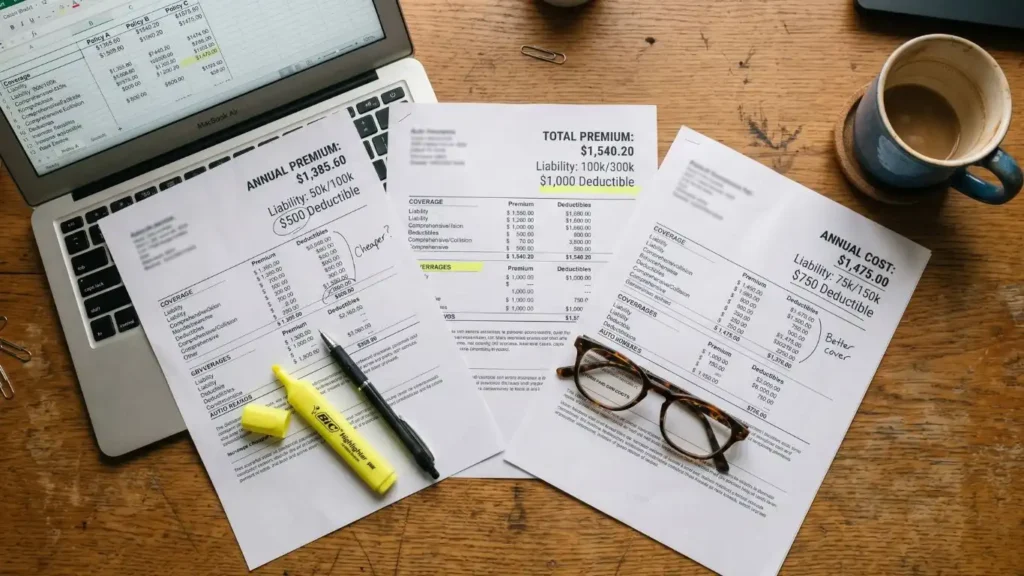
Check these four things on every quote:
| What to Check | Why It Matters |
|---|---|
| Financial strength rating | Tells you if the company can actually pay claims |
| Customer satisfaction score | Predicts how painful claims will be |
| Coverage limits and exclusions | The fine print that decides if you’re really covered |
| Available discounts | Real savings that don’t show up in the headline quote |
You can find financial strength ratings for free at the National Association of Insurance Commissioners website. The numbers are clean and government-backed.
If you’ve been with your current company a while, you might be sitting on loyalty perks like accident forgiveness or a vanishing deductible. Those vanish the second you switch. Subtract their value from the savings before you decide.
Step 4: Buy the New Policy and Pick Your Start Date
Once you’ve picked a winner, buy the new policy online or with an agent. This is the most important moment in the whole process.

Set your new policy’s start date to begin before your old one ends. Even one hour of overlap is fine and worth it. A coverage gap of even a single day can:
- Trigger fines from your state DMV
- Bump up your rate at every future renewal because you’re now considered “high risk”
- Get your license suspended in strict states like New York or Florida
- Cause your lender to force-place expensive coverage on your loan
Pay your first premium and download your new ID cards immediately. Save them to your phone.
Step 5: Cancel Your Old Policy in Writing
This part is your responsibility, not the new company’s. The new insurer cannot cancel the old one for you, no matter what their salesperson says.
Call your old insurer, then follow up with an email or written cancellation request. Three things to confirm:
- The exact cancellation date (should match or come slightly after your new policy start date)
- Whether you’re owed a refund for unused premium (you usually are)
- Any cancellation fee they’re charging
If you paid in full at the start of the year, you’ll likely get a prorated refund mailed in two to four weeks. Cancel any autopay you had set up, both with the insurance company and your bank, just in case.
The same documentation habit applies to other policies. Cancelling health insurance at any time follows different rules, but the “always get it in writing” principle is the same.
Step 6: Update Everyone Who Needs to Know
You’re almost done. The last step is letting the right people know about the switch.
The list usually looks like this:
- Your lender or leasing company. They’ll ask for proof of insurance from the new carrier within a few days.
- Your state DMV. A handful of states require you to report the change directly. Skip this, and you might get a fix-it ticket.
- Anyone listed as an additional driver. They need new ID cards, too.
- Your employer, if you use the car for work or get a stipend.
Replace the old ID cards in your glovebox and on your phone with the new ones. That’s it. You’re done.
Special Situations to Watch Out For
The basic six steps cover most people. The rest need a few tweaks.
How To Switch Car Insurance to a New Car
If you just bought a vehicle, you don’t have to start a fresh policy. You can transfer the existing one. Call your current company first because most carriers give you a grace period (usually 7 to 30 days) to add the new car automatically. Knowing how to switch insurance to a new car without a gap is just calling your insurer the day you take possession and asking them to add it. If you’re upgrading from a beater to something nicer, expect the rate to go up since newer cars cost more to repair.
Some buyers ask how do I switch my car insurance to another car mid-policy. The answer is the same: call, swap the VIN, get an updated declarations page, and the rate adjusts automatically. How to switch car insurance to a new car is more about timing than paperwork. Move fast, and your existing carrier handles everything.
How To Switch Car Insurance to Another State
Auto insurance is regulated state by state, so when you move, your old policy often can’t legally follow you. Big national carriers can usually transfer coverage; smaller regional ones cannot.
Step one: ask your current insurer if they write policies in your new state. If yes, they’ll re-rate you for the new ZIP code. If not, you have to start fresh. Figuring out how to switch car insurance to another state usually means doing all six steps above, but with a hard deadline tied to your move date. Most states give new residents 30 to 90 days to get a local policy before they fine you.
Don’t forget: car registration, driver’s license, and insurance all need to match the new state, usually within the same window.
How Hard Is It to Switch Car Insurance?
Not hard at all. The whole thing takes about 90 minutes if you’re organised. The hardest part is just sitting down to do it. Most people put it off for months, then save $600 a year once they finally spend an afternoon on it.
If you’ve ever booked a flight online, you can switch car insurance. The forms are similar, the math is simpler, and the stakes are lower than people think. Wondering how hard is it to switch car insurance is the same as wondering how hard it is to refinance a streaming service. It just feels big until you start.
Common Mistakes That Cost People Money
Even smart drivers slip up. Here are the traps to dodge:

Letting the old policy lapse before the new one starts. Already covered, but worth saying twice. Always overlap by at least one day.
Underinsuring to chase a low quote. Dropping from 100/300 liability down to 25/50 saves $30 a month and can wreck you financially in one accident.
Forgetting about bundling discounts. If you bundle home and auto, splitting them might cost more than it saves. Run the numbers both ways. The same logic applies if you carry gap insurance on your loan, since some new carriers don’t offer it.
Ignoring telematics programs. Most major carriers now offer plug-in or app-based programs that give discounts of 10 to 30% for safe driving.
Not asking about a continuous coverage discount. If you’ve been insured nonstop for six months or more, mention it. Most companies will knock 5 to 15% off just for that.
When Switching Is Probably a Bad Idea
Not every situation calls for a change. Skip the switch if:
- You’re in the middle of an open claim
- You have a recent ticket or at-fault accident (rates will be ugly anywhere)
- Your loyalty discounts add up to more than the new quote saves
- You’re inside a 90-day “binding period” with a new policy you just bought
In those cases, the smarter play is to call your current insurer, mention the competing quotes, and ask for a loyalty discount. Half the time, they’ll match or beat the new offer just to keep you. It’s the cheapest negotiation you’ll ever do.
For drivers who own a vehicle that isn’t titled in their name, the rules get tighter. Insuring a vehicle not in your name is possible, but it limits which carriers will write the policy. Make sure your shortlist actually accepts your situation before you waste an afternoon getting quotes.
FAQs
How often can you switch car insurance without raising red flags?
You can technically switch as often as you want, but switching more than once or twice a year can flag you as a high-risk customer in some carriers' systems. Insurers track shopping patterns through industry databases, and frequent switchers sometimes get denied "new customer" discounts or pay slightly higher rates. The sweet spot is shopping every 6 to 12 months and only actually switching when the savings are at least $200 a year. Anything more aggressive than that hurts more than it helps.
What documents do you need to switch car insurance?
You need five things ready before you start: your driver's license number, your vehicle's VIN, your current declarations page, your odometer reading, and your loan or lease info if you're financing. Some insurers also ask for your driving record from the last three to five years, but they usually pull that themselves. Having everything in one folder cuts the quote process from 20 minutes down to about 5. If you're adding household drivers, you'll need their license numbers too.
Can you switch car insurance if you have a ticket or recent accident?
Yes, you can switch even with a ticket or at-fault accident on your record, but expect higher quotes everywhere you shop. New insurers see your full driving history through reports like CLUE (Comprehensive Loss Underwriting Exchange) and MVR (Motor Vehicle Record), so hiding incidents won't work. In many cases, staying with your current insurer until the violation falls off your record (usually 3 to 5 years) saves more than switching. Get quotes anyway, because some companies are surprisingly forgiving of single incidents.
Will I get charged twice if my new policy starts before my old one is canceled?
You'll get billed by both companies for the overlap days, but you also get a prorated refund from the old insurer for any unused premium you already paid. Net cost is usually just a few dollars, and that small overlap is the whole point. It's the cheapest insurance against a coverage gap. If you paid the old policy in full upfront, the refund check usually arrives in 2 to 4 weeks. If you were on monthly billing, just confirm the cancellation date and stop the autopay so nothing recharges next month.
How To Switch Car Insurance Companies the Smart Way
The whole process boils down to one rule: never cancel before you replace. How to switch car insurance companies safely means treating the switch like changing tyres on a moving car. The new one goes on first, the old one comes off second, and you never stop rolling.
Once you understand how to switch car insurance, it stops feeling like a chore. Six steps, two phone calls, ninety minutes. People who actually go through with it tend to save somewhere between $400 and $700 a year. The math holds up almost every time.
The best window is right before your renewal date, with your new policy already in hand and your old one still active. Whether you’re moving, buying a different car, or just sick of getting overcharged, the steps don’t change. Pull the declarations page, run the quotes, and pick the policy that matches the way you actually drive, not the one with the loudest commercial.
That’s how to switch car insurance the right way, end of story.