Imagine this: A freelance graphic designer in Austin sets up a cozy home office, buys two high-end monitors, a drawing tablet, and thousands of dollars’ worth of design equipment. One evening, a pipe bursts in the wall behind the desk. Everything gets soaked. She calls her insurer expecting full coverage and finds out her standard homeowners policy only covers up to $2,500 of business property. Her total loss? Over $11,000.
That story plays out across thousands of American homes every single year. And the painful part is, most people never know the gap exists until they’re standing in a damaged room holding a claim form.
If you run any kind of business from your home even just a side hustle understanding home insurance with business use is one of the smartest things you can do with 15 minutes of your time.
What Is Home Insurance With Business Use?
Home insurance with business use is a type of coverage or a set of added protections designed specifically for people who use their home for work or business activities. It fills the space that a standard homeowners policy leaves wide open.
A regular homeowners policy is built to protect your house, your personal belongings, and your personal liability. The moment your home becomes a place where money is exchanged, clients visit, business equipment is stored, or professional services are delivered, your standard policy starts to become unreliable. It was simply not written with business activity in mind.
Home insurance with business use either expands your existing policy through an endorsement, or replaces it with a more complete coverage package that accounts for both your home and the business activity happening inside it.
Think of it like adding an extra room to a house. The original structure stays the same, but now there’s a space built specifically for what you actually need.
Why Your Standard Policy Probably Won’t Protect You
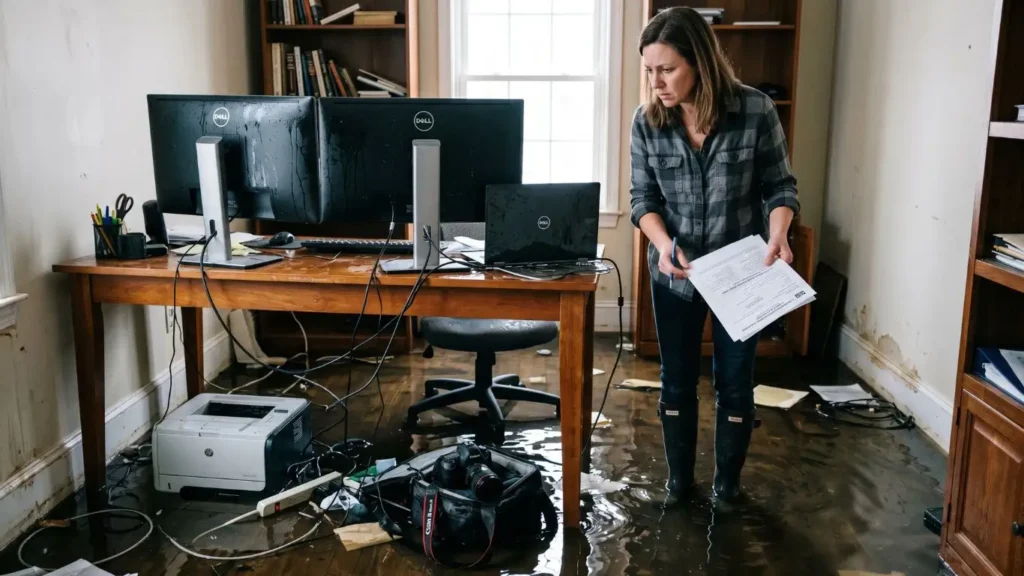
Here’s something most people are surprised to learn: most standard homeowners policies in the United States limit business property coverage to just $2,500. That’s not a lot not when you consider laptops, cameras, printers, specialized tools, inventory, or any professional equipment.
It goes further than just property, too. The liability section of a standard homeowners policy generally does not extend to business-related incidents. So if a client slips and falls while visiting your home studio, or a delivery person is injured dropping off a business shipment at your door, your personal policy may leave you paying those legal and medical costs out of pocket.
There’s also the question of what happens to your income. If a covered event like a fire or storm damages your home and forces you to stop working, your standard homeowners policy almost certainly won’t replace the income you lose during recovery. That’s a gap that can quietly devastate a small business.
This is exactly why home insurance with business use exists: to close these real, specific, and expensive holes in your protection.
The Three Main Options for Home Insurance With Business Use

When it comes to setting up proper home insurance with business use, there are three main paths most homeowners take. The right one depends on the size of your operation, how much equipment you have, and whether clients ever come to your home.
1. The Homeowners Policy Endorsement
This is the simplest and most affordable option. An endorsement is basically an add-on to your existing homeowners policy. It raises the limits for business property and may add some basic business liability protection.
This option works well if:
- Your home business is part-time or low-risk
- You don’t have clients visiting your property
- You have less than $5,000 worth of business equipment
- Your work involves mostly phone calls, email, or light admin tasks
The permitted incidental occupancies endorsement, for example, is a small add-on specifically designed for low-risk activities think writing, coaching calls, virtual consulting, or phone-based sales. If your business activity is simple and doesn’t bring physical visitors or heavy inventory into your home, this path is often the most practical starting point.
If you’re also navigating coverage decisions as a self-employed individual, combining the right home and health protections can make a real difference in your financial stability.
2. The In-Home Business Policy
An in-home business policy is a more comprehensive step up from an endorsement. It’s designed specifically for people who run an active business from home one that generates real revenue, involves business property worth protecting, and may bring clients or contractors to the premises.
This type of home insurance with business use typically covers:
- Business equipment and inventory
- Liability for client injuries on your property
- Loss of important documents or records
- Business interruption if your home is severely damaged
- Off-site business property (like equipment you take to client meetings)
This option tends to be the right fit for home-based consultants, tutors, photographers, childcare providers, personal trainers, and anyone running a legitimately active small business from their property.
3. The Business Owner’s Policy (BOP)
A Business Owner’s Policy commonly called a BOP is the most complete form of home insurance with business use protection. It bundles commercial general liability and commercial property coverage into one package.
A BOP makes the most sense when:
- Your business revenue is substantial
- You sometimes work in leased spaces outside your home
- You employ workers or independent contractors
- Your risk exposure goes beyond what an endorsement can handle
- You want your business room to grow without outgrowing your coverage
BOPs can also be extended with endorsements of their own including cyber liability coverage, professional liability (also called errors and omissions), and even commercial auto if vehicles are used for business purposes.
What Home Insurance With Business Use Actually Covers

Let’s break it down simply. When you have proper home insurance with business use in place, here’s what it can protect:
| Coverage Type | What It Protects |
|---|---|
| Business Personal Property | Computers, cameras, tools, inventory, office furniture |
| Business Liability | Legal costs if a client or visitor is injured at your home |
| Business Interruption | Lost income if a covered event forces you to stop working |
| Professional Liability | Claims that your work caused financial harm to a client |
| Cyber Liability | Data breaches, ransomware, or leaked client information |
| Off-Premises Property | Equipment stolen or damaged away from home |
| Loss of Records | Important documents, files, or accounts receivable |
It’s also worth knowing what is typically not covered, even with home insurance with business use add-ons:
- Commercial vehicles used for business (those need a separate commercial auto policy)
- Employees’ injuries (workers’ compensation is separate)
- Professional errors that lead to financial losses to clients (professional liability handles this separately)
- Business activity that fundamentally transforms your home into a commercial property
How to Know If You Actually Need It
Not every person who occasionally answers work emails from home needs to overhaul their insurance. But there are clear signs that your current policy is no longer enough.
You likely need home insurance with business use coverage if:
- You run a side business or full-time business from home
- You store business inventory, materials, or equipment at home
- Clients, customers, or contractors visit your property
- You handle sensitive client data, financial records, or personal information
- You rely on your home as the primary place your income is generated
- A loss of your home office or equipment would financially hurt your business
Even something as simple as understanding what your renters or homeowners policy does and doesn’t cover can reveal gaps you never expected.
A Step-by-Step Guide to Getting the Right Coverage
Getting home insurance with business use protection set up properly doesn’t have to be complicated. Here’s how to approach it:
Step 1: Take Stock of Your Business Assets
Write down every piece of equipment, inventory, or property tied to your business. Include purchase prices and approximate current values. This gives you a clear picture of how much coverage you actually need and it becomes useful documentation if you ever file a claim.
Step 2: Review Your Current Homeowners Policy
Pull out your existing policy and look specifically for the business property limits and the liability exclusions section. Most standard policies cap business property at $2,500. If your business gear exceeds that, you already know you have a gap.
Step 3: Identify the Nature of Your Business Risk
Does anyone come to your home for business? Do you handle client data? Do you use a vehicle for work? Each “yes” adds a layer of risk that a basic policy won’t address.
Step 4: Contact Your Current Insurer First
Ask whether a business endorsement can be added to your existing homeowners policy. This is often the most affordable path if your operation is small. Make sure to ask specifically whether your business activity could ever invalidate your current policy this is a real concern that most homeowners never think to raise.
Step 5: Get Quotes for an In-Home Business Policy or BOP
If your insurer can’t accommodate your needs, or if your business is large enough to warrant it, get separate quotes. Many specialty insurers offer packages tailored to home-based operations. Just as you would compare health plan options before enrolling, the same comparison mindset applies here.
Step 6: Review Annually
Your business will change. Your equipment inventory will grow. Your revenue might increase. Review your home insurance with business use coverage once a year to make sure it still fits.
The Real Cost of Not Having It
Marcus ran a small photography studio from the garage of his Kansas City home. He had a standard homeowners policy and never thought twice about it. When a break-in occurred and his $14,000 worth of camera equipment was stolen, his claim was largely denied because the gear was classified as business property not personal belongings.
Stories like Marcus’s are not rare. They’re the natural result of a mismatch between what a policy was designed to do and how a home is actually being used. The cost of proper home insurance with business use coverage is often a few hundred dollars per year. The cost of not having it can be catastrophic.
It’s also worth thinking about what happens to your income continuity when your workspace is damaged. Most people who work from home don’t think about income protection as a separate concern but when your home office is the engine of your income, protecting that engine is just as important as protecting the walls around it.
Common Misconceptions About Home Insurance With Business Use
My employer’s insurance covers me when I work from home
This is one of the most common assumptions — and one of the most dangerous ones. In most cases, your employer’s commercial policy covers incidents that happen on company property or during company-directed work. When you’re working remotely from your personal home, that coverage boundary becomes murky. You should never assume your employer’s policy protects your home, your equipment, or your personal liability.
My equipment is personal property, so it’s covered
Equipment used primarily for business purposes is typically classified as business property by insurers regardless of where it’s stored. A laptop you use 90% of the time for client work is generally considered a business asset, even if you bought it yourself and it sits on your home desk.
I only need coverage if I have a ‘real’ business
Even a small Etsy shop, a tutoring side gig, or a part-time photography business can create real liability and property risks. The size of your operation doesn’t determine whether a loss can hurt you financially. It only determines which level of home insurance with business use coverage is the right fit.
Adding business coverage will void my homeowners policy
Actually, the opposite is closer to the truth. Failing to disclose business activity to your insurer is what can create problems. Letting your insurer know about your business use and adding the appropriate coverage protects your policy rather than threatening it.
How Home Insurance With Business Use Interacts With Other Policies
Home insurance with business use doesn’t operate in a vacuum. It’s often one piece of a broader protection picture.
For example, if you drive your personal vehicle to pick up inventory, deliver products, or visit clients, your personal auto policy likely won’t cover an accident that happens during those trips. That’s a gap that requires a separate vehicle-related policy to close properly.
Similarly, if you have employees or regular contractors working at your home, workers’ compensation coverage becomes a separate and important consideration. And if you store sensitive client data financial records, health information, or personal details cyber liability coverage deserves a serious look.
The key insight is that home insurance with business use is a starting point, not a complete solution on its own. Building the right protection means understanding how all the pieces fit together.
How Insurers Determine Your Premium
When you apply for home insurance with business use coverage, insurers look at several factors to calculate your premium:
- Type of business activity A freelance writer is lower risk than a home daycare or auto repair shop
- Number of visitors Client foot traffic to your property raises liability exposure
- Value of business equipment and inventory Higher values mean higher premiums
- Revenue generated Some policies are tiered based on annual business income
- Data sensitivity Handling client financial or health data increases risk
- Claims history Prior claims on your home or business policies affect rates
The good news is that for most low-to-moderate risk home businesses, the added annual premium for proper home insurance with business use coverage is genuinely modest. A basic business endorsement might add $25 to $75 per year to your homeowners premium. An in-home business policy might run $250 to $500 annually. A full BOP starts higher but provides correspondingly broader protection.
Knowing whether you’re required to have certain types of coverage in your state can also help you plan your total insurance budget more accurately.
Special Situations That Require Extra Attention
Home Daycare and Childcare
Running a licensed daycare from your home creates elevated liability exposure. Children are on your property, under your supervision, and injuries can lead to serious legal claims. Standard homeowners policies and even basic business endorsements often exclude this specifically. A dedicated in-home business policy or a BOP with childcare endorsements is essential for this type of operation.
Renting Out Part of Your Home
If you rent a room, a basement apartment, or a detached garage to a tenant, that rental activity is treated as business use by most insurers. The rental unit is no longer covered under your standard homeowners policy as a personal structure. Understanding how different types of coverage apply to different parts of your property becomes critical in this situation.
Online Retail and Inventory Storage
Selling products online whether through your own site or a marketplace and storing that inventory at home creates both property and liability exposure. Products that injure customers can trigger product liability claims that a homeowners policy is completely unequipped to handle.
Professional Services
Accountants, therapists, attorneys, financial advisors, and other professionals who see clients at home or provide advice that clients rely on financially need professional liability coverage, also known as errors and omissions insurance. This is separate from general liability but equally important.
FAQs
Is home insurance with business use tax deductible in the US?
Partially, and the rules matter a lot here. If you are self-employed and use a
dedicated, exclusive area of your home for business a real home office, not
just your kitchen table the IRS allows you to deduct a proportionate share
of your home insurance premiums. That proportion is calculated by dividing the
square footage of your workspace by the total square footage of your home. You
claim this on Schedule C (Form 1040) or use IRS Form 8829. The key word the IRS
uses is "exclusive" the space needs to be used regularly and only for business,
not doubling as a guest room or family space. If your home insurance policy
includes a business endorsement or in-home business policy, the premium paid
specifically for that business coverage may be deductible as a direct business
expense. This is a legitimate tax benefit that most home-based business owners
leave on the table simply because they don't know it exists.
Does home insurance with business use cover Airbnb or short-term rental activity?
Standard home insurance with business use endorsements generally do not cover
short-term rental activity. This surprises a lot of hosts. Most homeowners
policies even ones with a basic business endorsement treat paying guests
as a commercial activity that falls outside the scope of personal residential
coverage. If you rent your property regularly through a platform like Airbnb or
VRBO, a standard home insurance policy will almost certainly leave you exposed
for guest injuries, property damage caused by guests, theft, and lost rental
income. The right path for short-term rental hosts is either a dedicated
home-sharing endorsement (if your insurer offers one) or a specialized
short-term rental policy. If the rental unit is not your primary residence,
an endorsement is usually not even an option you would need a standalone
commercial rental policy. The bottom line: hosting paying guests is a business
activity, and it needs to be treated like one from an insurance standpoint.
How does home insurance with business use work if employees or contractors come to my home?
This is where a basic homeowners endorsement quickly runs out of road. If
workers whether paid employees or regular independent contractors come to
your home as part of your business operations, you are introducing a level of
liability that most residential policies simply aren't built to handle. A
standard homeowners policy covers personal liability for incidents involving
guests, but workers who are there for business purposes are a different legal
category entirely. If a contractor is injured at your property during a
business-related task, your homeowners policy is unlikely to cover it. For
employees, workers' compensation insurance is a separate legal requirement in
most US states once you have staff on payroll your home insurance policy has
nothing to do with that obligation. If contractors regularly visit your home
for business reasons, an in-home business policy or a BOP with general liability
coverage is the appropriate level of protection, not a basic endorsement.
Will adding home insurance with business use coverage raise my premium significantly?
For most low-to-moderate risk home businesses, the cost increase is smaller than
most people expect. A simple homeowners policy endorsement that raises your
business property limit from $2,500 to $5,000 can cost as little as $25 to $75
per year. An in-home business policy which provides more complete coverage for
equipment, liability, and business interruption typically runs between $250
and $500 annually. A full Business Owner's Policy (BOP) starts higher, but
provides correspondingly broader protection and makes sense when your business
revenue or risk exposure has grown. What does raise your premium more noticeably
is having clients regularly visit your property, storing significant inventory
at home, handling sensitive customer data, or operating a higher-risk type of
business such as childcare or food production. The nature of what you do and who
physically comes to your home matters more to an underwriter than the simple
fact that you work from home.
The Bottom Line on Home Insurance With Business Use
If your home is also your workplace, your regular homeowners policy has a boundary and that boundary is drawn at the word “business.” Everything on the business side of that line is your responsibility to protect.
Home insurance with business use is not a luxury or an optional extra. For the millions of Americans who work from home, run side businesses, freelance professionally, or operate home-based operations of any kind, it’s a foundational piece of financial protection.
The right coverage depends on your specific situation the size of your business, the nature of your work, how much equipment you own, and who interacts with your property. But the starting point for everyone is the same: review what you have, understand what it actually covers, and fill the gaps before a loss makes them visible.
A policy review today can be the thing that keeps a flooded home office or a client injury from turning into a financial emergency tomorrow. That’s not a small thing that’s the whole point of insurance.