
Picture this: you twist your ankle on a Sunday hike, your doctor orders a CT scan on Monday, and by Friday, a $2,400 bill lands in your mailbox. You had insurance. You did everything right. So why the shock? That moment happens to thousands of insured people every week, and it almost always comes down to one thing: nobody told them how the math actually works before the scan. This guide fixes that. By the end, you’ll know exactly how much is a CT scan with insurance in 2026, what your plan really pays, and the small steps that can shave hundreds off your bill.
The Quick Answer Most People Are Looking For
If you have decent commercial health coverage, a routine CT scan in 2026 will usually cost you between $100 and $1,500 out of pocket. The total billed price often sits between $300 and $6,750, but your share depends on three things: where the scan is done, whether you’ve met your deductible, and your coinsurance percentage.
Here’s a snapshot most people find useful:
| Scenario | Typical Out-of-Pocket Cost |
|---|---|
| Deductible already met, in-network imaging center | $50 to $250 |
| Deductible already met, hospital outpatient | $200 to $600 |
| Deductible NOT met, in-network | $400 to $1,800 |
| High-deductible plan (HDHP), full price applies | $600 to $3,200 |
| Medicare Part B, after deductible | About 20% of approved amount |
These are real-world ranges based on claims data, not sticker prices. Now let’s break down why the gap is so wide.
Why Your Bill Looks Different Than Your Neighbor’s
Two coworkers can get the same chest CT at the same hospital and pay wildly different amounts. The difference is hidden inside their plan documents.
How much is a CT scan with insurance depends on a few moving parts working together:
- Your deductible status. If you haven’t spent your $1,500 yearly deductible yet, you’re paying the full negotiated rate until you do.
- Your coinsurance split. Most plans pay 70% to 80% after the deductible, leaving you with 20% to 30%.
- Your copay. Some plans skip coinsurance for imaging and charge a flat fee, often $100 to $400.
- In-network vs. out-of-network. Out-of-network can double or triple your share, sometimes more.
- Place of service. A hospital outpatient department charges a “facility fee” that a freestanding center does not.
A friend of mine, Jenna, learned this the hard way last spring. Her doctor sent her to the imaging center inside the hospital because it was “convenient.” The same scan at a standalone center across the street would have cost her $340 instead of $1,180. Same machine. Same radiologist group. Different billing address.
CT Scan Costs by Body Part in 2026
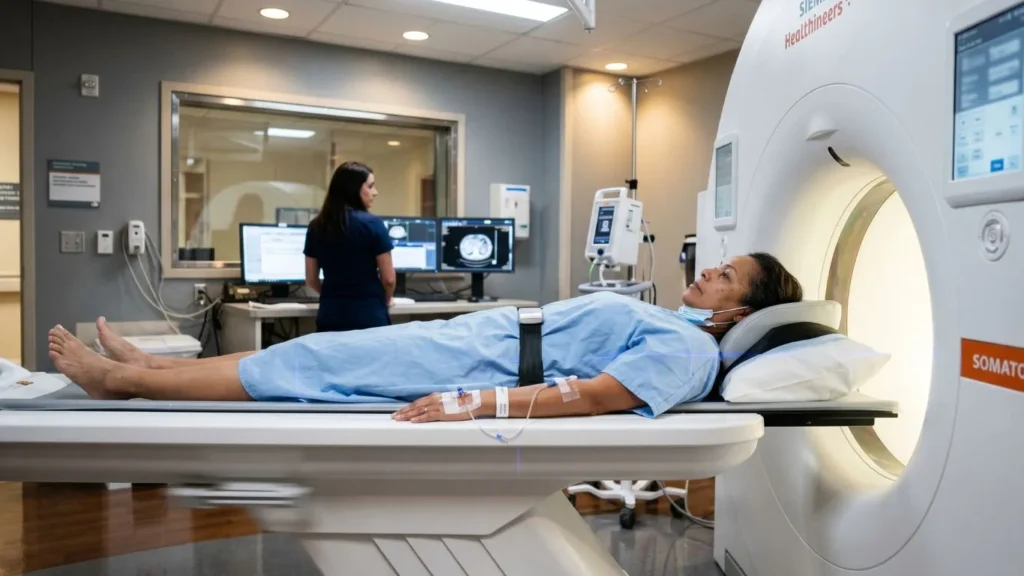
How Much Is a CT Scan With Insurance? Different scans take different amounts of time, contrast dye, and reading effort, so prices shift by body region. The numbers below reflect what insured patients typically see after their plan applies.
| Type of CT Scan | Average Total Charge | Typical Insured Cost |
|---|---|---|
| Head / Brain CT | $300 to $1,500 | $90 to $450 |
| Chest CT | $400 to $2,200 | $120 to $660 |
| Abdomen CT | $500 to $2,800 | $150 to $840 |
| Pelvis CT | $400 to $2,400 | $130 to $720 |
| Abdomen + Pelvis CT | $700 to $3,500 | $210 to $1,050 |
| Sinus CT | $300 to $1,200 | $90 to $360 |
| Spine / Lumbar CT | $500 to $2,500 | $150 to $750 |
| CT Angiography | $1,000 to $4,500 | $300 to $1,350 |
| Full Body CT | $1,500 to $6,750 | $450 to $2,025 |
If you’re searching for how much is a head ct scan with insurance, expect the lower end of the range because head scans are quick and rarely use contrast. A typical head CT costs between $90 and $450 once your insurance applies. For trauma cases ordered through the ER, your share could climb because of facility fees attached to the visit.
With Contrast vs. Without Contrast
Contrast dye highlights blood vessels, organs, and soft tissue so radiologists can spot tumors, clots, and bleeds with more confidence. The trade-off is cost. A scan with contrast adds roughly $100 to $500 to the total charge because it involves an extra prep step, an IV line, and the dye itself.
Many readers also wonder about how much is a ct scan with contrast without insurance. Self-pay patients usually face $500 to $3,200 for a contrast CT, with abdominal and pelvic scans landing on the higher end. The same scan with insurance generally drops your share to $200 to $900 once your deductible has been hit. If you’re paying cash, ask the imaging center for their “prompt-pay” or self-pay rate. These are often 30% to 60% lower than the insured negotiated rate, which catches a lot of people off guard.
For situations where coverage is in question, our guide on whether health insurance can be canceled at any time walks through what happens to scheduled scans during a coverage gap.
The Three Numbers That Decide Your Bill
How Much Is a CT Scan With Insurance? Most plans run on the same three levers. Once you understand them, your bill stops feeling random.
1. Deductible. This is the amount you pay before insurance starts chipping in. A $1,500 deductible means the first $1,500 of scans, labs, and other covered care comes out of your pocket. Many people first searching how much is a CT scan with insurance are surprised to learn the answer can simply be “the full negotiated rate” if they haven’t hit their deductible yet.
2. Coinsurance. After the deductible, your plan pays a percentage and you pay the rest. A 20% coinsurance on a $1,200 scan means you owe $240. Higher tiers like Bronze plans often have 30% to 40% coinsurance, while Gold and Platinum plans drop closer to 10%.
3. Out-of-pocket maximum. This is your safety net. Once your spending hits the cap, usually $4,000 to $9,450 for a single person in 2026, your plan covers 100% of in-network care for the rest of the year. If you’ve had a rough year medically, this number changes everything. To understand the broader plan structure that drives these numbers, our deeper read on what makes up a health insurance premium is worth a look.
Step-by-Step: How to Find Out What You’ll Actually Pay
Stop guessing. The process below takes about 25 minutes and will tell you the real number before you ever lie down on the scanner table.

Step 1: Get the CPT code from your doctor’s office
Every CT scan has a five-digit CPT code. A head CT without contrast is 70450. An abdominal CT with contrast is 74160. Without this code, no one can give you an accurate quote.
Step 2: Call your insurance member services line
Read them the CPT code and ask three questions: Is this scan covered? What’s the in-network negotiated rate? How much have I already paid toward my deductible?
Step 3: Call two or three in-network imaging centers
Give them the CPT code and ask for their cash price and their negotiated rate with your insurer. Freestanding imaging centers nearly always beat hospital outpatient pricing.
Step 4: Ask about prior authorization
Many plans require pre-approval for advanced imaging. If your provider skips this step, your claim can be denied even when the scan was medically necessary. The clinic usually handles this, but confirming saves headaches.
Step 5: Compare the totals
Add the deductible portion, coinsurance, and any facility fees. The lowest realistic number is your target. If a hospital quote is $1,400 and a standalone center quote is $410, the choice is obvious.
Step 6: Get the quote in writing
A printed estimate or email is your protection if a surprise bill shows up later.
A Real Anecdote That Shows Why Step 3 Matters
Last year, a reader named Marcus needed an abdomen and pelvis CT with contrast. His doctor’s office casually mentioned, “We usually send patients to County General.” He made three calls anyway:
- County General Hospital: $2,890 billed, $980 his share after coinsurance
- A health-system-owned imaging suite: $1,640 billed, $560 his share
- A freestanding radiology center: $740 cash price, $185 his share with insurance
Same scan. Same quality. A $795 difference between the highest and lowest insured price. That’s a car payment, a month of groceries, or a flight home for the holidays.
Medicare and CT Scan Pricing in 2026
How Much Is a CT Scan With Insurance? Medicare beneficiaries play by a different set of rules. Original Medicare Part B covers medically necessary outpatient CT scans at 80% of the Medicare-approved amount. Your share is the remaining 20% plus the annual Part B deductible, which is $257 in 2026.
A few specifics worth knowing:
- Hospital inpatient CT scans fall under Part A and roll into your hospital deductible.
- Medicare Advantage plans sometimes have lower copays but may require referrals or in-network imaging centers.
- Medigap plans can cover most or all of the 20% coinsurance, depending on the letter plan you bought.
- Lung cancer screening CT scans are covered with no out-of-pocket cost for eligible smokers and former smokers ages 50 to 77.
How to Pay Less Even If You’re Insured
How Much Is a CT Scan With Insurance? Plenty of insured patients still feel squeezed by imaging bills. These tactics consistently knock down what you owe.

- Choose freestanding over a hospital. This is the single biggest lever. Independent imaging centers run 30% to 70% cheaper for the same scan.
- Time your scan strategically. If you’ve already met your deductible, schedule the scan before the calendar year resets.
- Ask for the cash price. If your insured price is higher than the cash price, pay cash and submit the receipt for out-of-network reimbursement, or just take the savings.
- Negotiate the bill after the fact. Hospitals will often accept 40% to 60% of a high balance, especially if you offer to pay in a lump sum.
- Check your Explanation of Benefits (EOB) carefully. Billing errors happen on roughly 1 in 10 imaging claims. Fight every line you don’t recognize.
- Use FSA or HSA dollars. Pre-tax money lowers the real cost by 20% to 35%, depending on your tax bracket. Our piece on whether life insurance is tax-deductible covers a related angle on tax-advantaged health spending.
What Happens If You’re Uninsured or Underinsured
How Much Is a CT Scan With Insurance? Self-pay patients face the trickiest pricing. Without a network, you’re quoted “chargemaster” rates, which are basically inflated list prices. The good news is that imaging centers expect you to negotiate.
A no-contrast head CT often runs $300 to $1,500 cash. A standard chest CT runs $400 to $2,200. The same procedure billed through insurance on a high-deductible plan can sometimes cost more than paying cash, which is why how much is a ct scan with contrast without insurance is a question worth asking, even when you have a card in your wallet.
If you’re between jobs or weighing whether to stay covered, our breakdown on how much urgent care costs without insurance gives a parallel view of self-pay medical costs. And for those questioning the legality of going without coverage, the legal status of being uninsured in 2026 is a fast read.
CT Scan vs. MRI vs. X-Ray: Cost Comparison
People often ask whether they should just get an X-ray instead. Here’s how the three stack up on price and use case.
| Imaging Type | Average Cost (Insured) | Best For |
|---|---|---|
| X-Ray | $30 to $200 | Bone fractures, simple chest checks |
| CT Scan | $90 to $1,500 | Trauma, internal bleeding, tumors, complex bone |
| MRI | $300 to $2,800 | Soft tissue, brain, spine, ligaments |
CT scans hit a sweet spot for speed and detail. They’re faster than MRIs, more detailed than X-rays, and usually cheaper than MRIs. For a deeper look at how medical billing nuances apply elsewhere, our overview of dental cleaning costs without insurance shows similar patterns at play.
Common Reasons Insured Patients Get Surprise Bills
Even when you do everything right, surprise bills sneak in. The most frequent causes:
- The radiologist was out-of-network even though the imaging center was in-network. The No Surprises Act of 2022 protects you from most of these in 2026, but errors still happen.
- The scan was downgraded from medically necessary to elective by your insurer. Always confirm prior authorization is on file.
- A second scan or extra view was added during the appointment. Ask before consenting to anything beyond the original order.
- Contrast dye was billed separately under a different code.
If any of these hit you, file an appeal in writing within 30 days. Insurer reversals on imaging appeals run higher than 50% when patients push back with documentation. For comparable cost research patterns, you might also want to read our analysis of crown costs without insurance, where similar negotiation tactics apply.
FAQs
Can I refuse a CT scan if my doctor orders one and I'm worried about the cost?
Yes, you have the full right to refuse any non-emergency scan. Patients turn down imaging every day for cost, radiation concerns, or wanting a second opinion first. The smart move is to ask your doctor two questions before saying no: "What changes in my treatment if we skip this scan?" and "Is there a cheaper alternative like an ultrasound or X-ray that gives you enough information?" If the answers don't justify the cost, request a different diagnostic path or a referral to a freestanding imaging center where the price drops significantly.
Why does my insurance say the CT scan is covered but I still got a huge bill?
"Covered" doesn't mean "free." It just means the scan falls under your plan's benefits. You're still responsible for any unmet deductible, your coinsurance percentage, copays, and any facility fees if the scan happened at a hospital outpatient department. A bill that feels too high often comes from one of three places: the deductible wasn't met, the radiologist or facility billed under a different network status, or the scan was coded as diagnostic instead of preventive. Always request an itemized bill and your Explanation of Benefits side by side to spot the issue.
How long do I have to pay a CT scan bill before it hurts my credit?
Medical debt under $500 will not appear on your credit report at all under the 2023 credit bureau rules still active in 2026. For larger balances, providers typically wait 90 to 180 days before sending the account to collections, and once in collections, the debt now has a one-year grace period before it can damage your credit score. Use that window to negotiate. Most hospitals will accept 40% to 60% of the balance as a lump-sum settlement, set up zero-interest payment plans, or qualify you for financial assistance based on income.
Will getting a CT scan raise my health insurance premiums next year?
No, individual claims do not directly raise your premiums. Health insurance pricing in the United States is based on age, location, tobacco use, and the broader risk pool of your plan, not your personal claim history. Federal law actually prohibits insurers from charging you more because you used your benefits or had a serious diagnosis. The exception is if you switch to a short-term medical plan or non-ACA coverage, where pre-existing conditions and prior claims can affect your rate. As long as you stay on a marketplace, employer, or Medicare plan, one CT scan won't move the needle.
Putting It All Together
So, back to the central question: how much is a CT scan with insurance in 2026? The honest answer is “between $50 and $1,500 for most insured Americans, with the median sitting around $300 to $500 per scan.” Your specific number depends on your plan tier, deductible status, and where you choose to get scanned.
How Much Is a CT Scan With Insurance? The single most powerful move is choosing a freestanding imaging center over a hospital, then asking for an itemized estimate before booking. People who do these two things alone save an average of $400 to $900 per scan. For added context on how high-cost medical care can stack up across professions, our look at malpractice insurance pricing shows how medical billing complexity ripples outward.
How Much Is a CT Scan With Insurance? For federal-level price transparency data, the Centers for Medicare & Medicaid Services Hospital Price Transparency tool lets you compare actual negotiated rates at hospitals near you. It’s clunky but accurate, and it’s the most authoritative free resource on real-world imaging costs.
Whether you’re scheduling your first scan or your fifth, knowing how much is a CT scan with insurance in your specific situation is the foundation. The math is learnable. The savings are real. And once you’ve worked the system once, you’ll never walk into an imaging appointment blind again.