Imagine this: You run a growing content agency. Your team publishes three blog posts a day, manages five brand social media accounts, and produces a weekly podcast. Business is booming. Then one morning, a lawyer’s letter lands in your inbox. A competitor claims your recent article defamed their company. The lawsuit demands $200,000 in damages.
You had no intention of causing harm. You thought the content was accurate. But here you are, staring at a legal bill that could shut your business down overnight.
This is not a rare story. Content businesses face these situations far more often than most people realize. And this is exactly where media liability insurance steps in as your financial safety net.
What Is Media Liability Insurance, Really?
Media liability insurance is a specialized type of professional liability coverage designed to protect people and businesses that create, publish, or distribute content. It is also called media professional liability insurance, errors and omissions (E&O) insurance, or communications liability insurance, but they all refer to the same protection.
In simple terms: if someone claims that your content harmed them financially, damaged their reputation, or violated their privacy, media liability insurance helps pay for your legal defense, settlements, and court judgments.
Think of it this way. If a plumber accidentally floods your kitchen, general liability insurance covers the water damage. But if a blogger accidentally publishes something that damages a brand’s reputation, general liability insurance usually will not help. That is where media liability insurance coverage fills the gap.
According to industry data, the average cost of a copyright infringement lawsuit in the US can exceed $150,000 in legal fees alone, even before any settlement. For a small content business, that kind of expense can be devastating without the right protection in place.
Who Actually Needs Media Liability Insurance?
A lot of people assume this coverage is only for big TV networks or newspapers. That is a common and costly misconception.
If you create or distribute content in any form, you are exposed to media liability risk. This includes:
- Bloggers and independent writers who publish articles, opinions, or reviews
- Podcasters who discuss brands, people, or events publicly
- Social media managers handling content for client accounts
- Advertising and PR agencies creating campaigns for businesses
- Authors who publish books, ebooks, or guides
- Video content creators on YouTube, TikTok, or streaming platforms
- Digital marketing consultants writing copy or managing ads
- News and media outlets of any size
Social media liability insurance has become especially important as platforms have grown. A single post shared thousands of times can trigger a defamation claim before you even realize what happened.
Even businesses outside the traditional media world need to think about this. Any company that runs a blog, sends marketing emails, or creates branded content is technically publishing media. That means they face the same legal risks as a professional publisher. Understanding business liability insurance requirements is a smart first step before applying for any specific policy.
What Does Media Liability Insurance Coverage Actually Cover?
Here is a straightforward breakdown of what a standard media liability insurance policy typically covers:
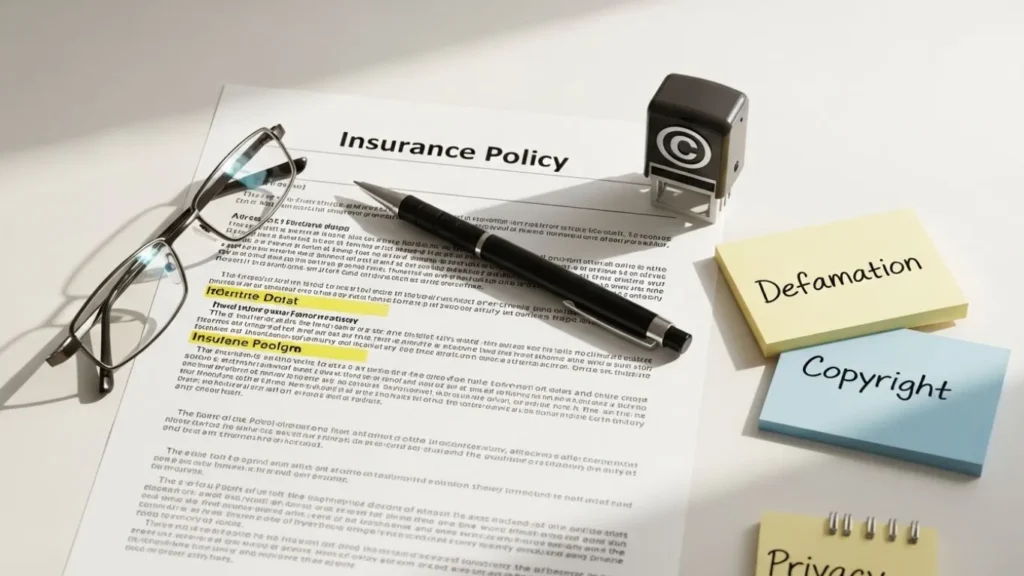
Defamation: Libel and Slander
Defamation happens when false statements damage someone’s reputation. Libel is the written form; slander is spoken. Content businesses are especially vulnerable because nearly everything they produce is published and can be read or heard by thousands of people.
If a business sues you for writing that their product is dangerous, or a person claims your podcast episode made false statements about them, media liability insurance covers your legal defense costs and any resulting settlement.
Copyright and Trademark Infringement
Using someone else’s photos, music, video clips, or written content without permission is copyright infringement. It happens more often than you might think, sometimes completely by accident.
A graphic designer on your team grabs an image from a Google search. A freelancer uses a music track they found online for the video intro. These honest mistakes can turn into expensive lawsuits. Electronic media liability insurance and broader policies both address these risks.
Invasion of Privacy
Publishing private information about a person without their consent, or using someone’s image in content without permission, is considered an invasion of privacy. This is a growing risk as personalized content and case studies have become so common in content marketing.
Advertising Injury
This covers false advertising claims, misleading content, or campaigns that unfairly disparage a competitor. General liability policies typically exclude advertising injuries for media businesses because of the elevated risk level in this industry.
Errors and Omissions in Professional Services
If you are a media agency or freelancer providing services to clients, media professional liability insurance also covers mistakes in your professional work. A missed deadline that caused your client a financial loss, an error in a press release that led to reputational damage, or content that was approved but contained inaccurate data can all lead to E&O claims.
What Media Liability Insurance Does NOT Cover
Being clear about exclusions is just as important as knowing what is covered. Standard media liability insurance policies do not cover:
| Exclusion | Why It Matters |
|---|---|
| Intentional or criminal acts | If you knowingly publish false content, no policy will protect you |
| Patent infringement | Requires a separate specialized policy |
| Bodily injury or property damage | Falls under general liability coverage |
| Employment disputes | Requires Employment Practices Liability Insurance (EPLI) |
| Breach of contract | Usually excluded unless content-related |
| Securities fraud | Completely outside the scope of media coverage |
Understanding these gaps is a core part of mastering liability risk assessments for media insurance in personal finance and building a complete protection strategy.
How Much Does Media Liability Insurance Cost?
Media liability insurance cost is one of the most searched questions by content business owners. Here is an honest, straightforward breakdown.

Typical cost range for US businesses:
| Business Type | Estimated Monthly Cost | Annual Premium |
|---|---|---|
| Freelance blogger or author | $40 – $70 | $480 – $840 |
| Small content agency | $70 – $150 | $840 – $1,800 |
| Mid-size media company | $150 – $400+ | $1,800 – $4,800+ |
The median monthly cost reported across the industry is around $78 per month. However, several factors push that number up or down:
Factors that affect your premium:
- Content volume: The more content you publish, the more exposure you carry
- Audience reach: A national campaign carries more risk than a local newsletter
- Industry sensitivity: Health, finance, and legal content face tighter scrutiny
- Claims history: Past lawsuits or disputes will raise your premium
- Coverage limits: Policies commonly range from $500,000 to $1 million per claim, with large publishers sometimes seeking coverage in the hundreds of millions
- Policy type: Claims-made policies are generally less expensive than occurrence-based policies
Media liability insurance for authors, for example, typically sits on the lower end of the cost spectrum, while a digital advertising agency managing national campaigns will likely pay more.
One practical way to reduce your premium is bundling. Combining cyber media liability insurance with your standard media policy often brings discounted rates. Insurers prefer bundled policies because it simplifies claims handling and reduce disputes over which policy applies when an incident overlaps two categories. You can learn more about how bundling affects overall costs when reviewing business personal property insurance options alongside your media coverage.
Claims-Made vs. Occurrence: Which Policy Type Is Right for You?
This is one of the most important decisions you will make when choosing media liability insurance coverage, and many content business owners overlook it completely.
Claims-made policies cover claims that are filed during the active policy period, regardless of when the content was originally published. Most modern media liability insurance policies are written on a claims-made basis. These tend to be more affordable but come with stricter reporting deadlines. Some require you to notify your insurer of a potential claim within 30 days.
Occurrence-based policies cover incidents that happen during the policy period, no matter when the claim is actually filed. So if you published content in 2023 and a lawsuit is filed in 2026, an occurrence policy from 2023 would still respond.
For content businesses with a high volume of archived content, occurrence-based policies often provide better long-term protection. For newer businesses managing active budgets, a claims-made policy is often the practical starting point.
Social Media Liability Insurance: A Growing Need in the Creator Economy
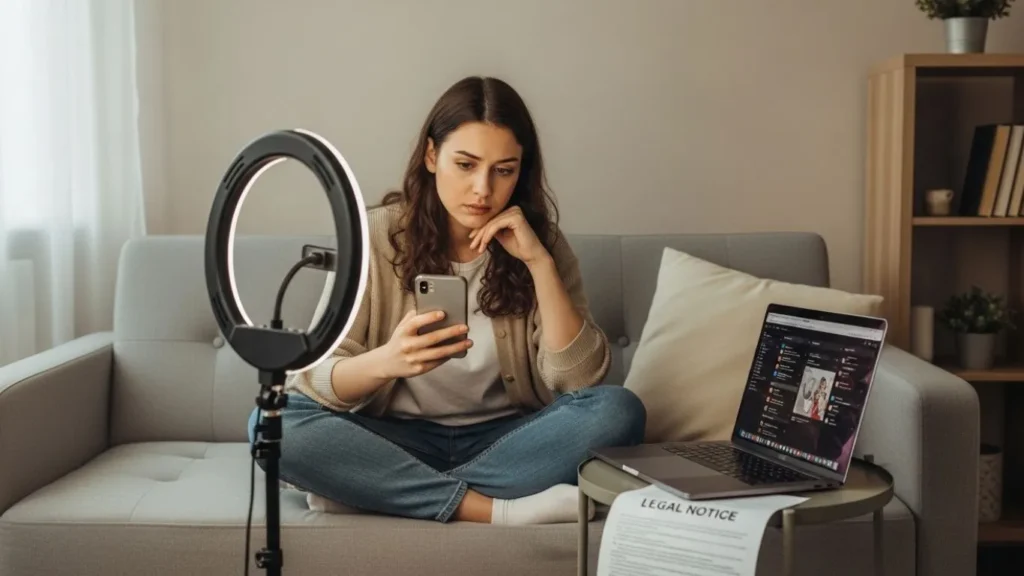
The rise of influencer marketing, brand partnerships, and social media content management has created a new category of risk that did not exist a decade ago. Social media liability insurance is either a standalone policy or an endorsement within broader media liability insurance coverage designed specifically for these risks.
Consider this scenario: A social media manager posts a sponsored story for a brand. The post includes a before-and-after health claim that the brand did not fully verify. A competitor reports the post for false advertising. The brand now faces an FTC inquiry and a potential lawsuit. Because the agency created and published the content, they share that liability.
As a content or social media professional, your exposure is real. Posts get screenshotted. Campaigns go viral. Claims travel faster than corrections. Social media liability insurance protects you when that speed works against you.
Proper liability communication plans: essential strategies for media insurance success should include a clear process for reviewing sponsored content, documenting client approvals, and having a defined response plan when claims arise.
Cyber Media Liability Insurance: Why Digital Businesses Need Both
Content businesses today face a dual threat: traditional media liability risks and modern cyber risks. Media liability cyber insurance, or cyber media liability insurance, is a hybrid policy that addresses both in a single package.
What cyber media coverage adds:
- Data breach response costs
- Notification expenses when customer data is exposed
- Network interruption losses
- Ransomware response
- AI-generated content risks (an increasingly common source of copyright disputes)
AI tools have introduced a new layer of uncertainty. If your team uses generative AI to write marketing copy or create images, and that content inadvertently reproduces copyrighted text or closely resembles someone’s protected work, you can face an intellectual property claim. Electronic media liability insurance policies that include AI content provisions are now being offered as this risk becomes more common.
This is a coverage area where most smaller content businesses are completely unprotected today. Reviewing long-term insurance planning strategies can help you think about future-proofing your coverage as the digital landscape continues to shift.
How to Get Media Liability Insurance: A Step-by-Step Guide
Getting the right coverage is not as complicated as it might seem. Here is how to approach it:
Step 1: Identify your content risks
Write down every type of content your business creates. Include blogs, social posts, podcasts, videos, whitepapers, email campaigns, and press releases. Note any content that discusses competitors, uses third-party images or music, or covers sensitive industries like health, finance, or law.
Step 2: Determine your coverage limits
Small businesses typically start with $500,000 to $1 million in per-claim coverage. If you work with large clients, run national campaigns, or publish high-volume content, consider higher limits from the start.
Step 3: Complete a media liability insurance application
A media liability insurance application typically asks about your business type, annual revenue, types of content produced, distribution channels, past claims, and existing policies. Being thorough and honest here ensures you get accurate quotes and avoids coverage disputes later.
Step 4: Compare quotes from multiple insurers
Get at least three quotes. Rates vary considerably between providers. Some insurers specialize in certain types of media businesses, and that specialization can mean better-tailored coverage and more competitive pricing.
Step 5: Review exclusions carefully
Before signing anything, read the exclusions section in detail. Know what your policy will not cover and assess whether you need additional endorsements to close those gaps.
Step 6: Reassess annually
As your business grows, your content volume and audience reach grow too. A policy that was right for you at $300,000 in annual revenue may be insufficient when you reach $1 million. Set a calendar reminder to review your media liability insurance coverage every year.
Understanding how to approach liability dispute resolution in media insurance before a claim happens is far easier than learning it under pressure.
Real-World Scenarios Where Media Liability Insurance Pays Off
Scenario 1: The borrowed image
A content marketing team uses a stock photo website to source images. One team member pulls an image from a Google search instead, not realizing it was a professional photographer’s copyrighted work. The photographer’s licensing company sends a cease and desist and a $12,000 invoice. Media liability insurance covers the negotiation costs and settlement.
Scenario 2: The podcast episode
A podcast host discusses a local restaurant’s health code violations based on public records. The restaurant owner claims the framing was defamatory and sues for $80,000. Even though the host believes the coverage was fair and accurate, defending the claim costs $30,000 in legal fees before it is dismissed. Media professional liability insurance covers those defense costs.
Scenario 3: The sponsored post dispute
A freelance social media manager runs a promoted campaign for a supplement brand. The campaign uses superlatives like “the best,” which a competitor claims constitutes false advertising. The resulting dispute costs $15,000 to resolve. Social media liability insurance absorbs the cost.
Media Liability Insurance News: What Is Changing in 2025 and Beyond
The media liability insurance landscape is shifting quickly. Here are the most important trends shaping the market right now:
AI content liability is one of the fastest-growing risk areas. As more businesses use AI writing and image generation tools, claims related to unintentional copyright reproduction and defamatory AI outputs are increasing. Carriers are now actively writing exclusions around this unless specific AI endorsements are added to policies.
Privacy regulations are tightening. State-level data privacy laws are creating new exposure for content businesses that collect user data, run retargeting campaigns, or publish personalized content. Policies that include media liability cyber insurance components are increasingly important.
Influencer and creator economy growth is driving demand for social media liability insurance products tailored to individuals rather than companies. Several specialty carriers are developing standalone creator policies to meet this need.
International coverage gaps remain a challenge. Many standard US media liability insurance policies do not cover claims filed outside the United States. If your content reaches an international audience, verify your policy’s geographic scope.
Staying informed about media liability insurance news and policy updates can mean the difference between being fully protected and having a costly gap in your coverage when you need it most.
FAQs
Can an e-commerce or retail business need media liability insurance even if they are not a media company?
Absolutely. E-commerce and retail brands are increasingly exposed to media liability risks through their digital marketing activities. Product descriptions that reference a competitor, social media promotions that use unlicensed images, customer testimonials that contain unverified health claims, and influencer campaigns with undisclosed sponsorships can all trigger media liability claims. The fact that your core business is selling products, not publishing content, does not reduce your legal exposure. Any business running an active online presence through a website, blog, email campaigns, or social platforms is creating content and therefore carrying media liability risk.
What happens if a media liability claim is filed after my policy has expired?
This depends entirely on whether your policy was written on a claims-made or occurrence basis. If you had a claims-made policy and it has since expired or been cancelled, a claim filed after that expiration date will generally not be covered unless you purchased an extended reporting period endorsement, commonly called a "tail" policy. A tail policy allows claims to be reported for a set period after your coverage ends, typically one to three years. If you had an occurrence-based policy, you are covered for any incident that happened during the policy period, regardless of when the claim is actually filed. This is why understanding your policy type before renewing or cancelling coverage is critically important for content businesses.
Does media liability insurance cover content created using AI tools?
This is a rapidly evolving area and the honest answer is: it depends on your specific policy and when it was written. Traditional media liability insurance policies were not designed with AI-generated content in mind. Many standard policies do not explicitly include or exclude AI content risks, which creates a gray area. Some newer policies and endorsements are beginning to address AI-specific exposures, such as copyright claims arising from AI outputs that reproduce protected text or imagery, and defamation claims from AI-generated content that fabricates false statements. If your business regularly uses AI writing tools, image generators, or AI-assisted video production, you should specifically ask your insurer whether these activities are covered and request a written clarification or endorsement confirming that coverage.
Is media liability insurance tax deductible for content businesses?
In most cases, yes. For US-based businesses, media liability insurance premiums are generally considered an ordinary and necessary business expense under IRS guidelines, which makes them tax deductible. This applies whether you are a sole proprietor, LLC, S-corp, or corporation. The deduction is typically claimed as a business expense on your tax return rather than as a personal deduction. However, the exact tax treatment can vary based on your business structure, how the policy is structured, and your overall financial situation. It is always recommended to confirm the deductibility of any insurance premium with a qualified tax professional who understands your specific circumstances.
Bringing It All Together
Media liability insurance is not a luxury reserved for large publishing empires. It is a practical, affordable, and often essential form of protection for any business that creates content as part of its operations.
Whether you are a solo author, a growing content agency, a podcaster building an audience, or a brand running social campaigns, the legal risks associated with publishing are real. One lawsuit can cost more than an entire year’s revenue for a small business. The right media liability insurance coverage means you can keep creating confidently, knowing that honest mistakes will not become financial catastrophes.
The cost is manageable. The process is straightforward. The protection is real.
For any business in the content space, getting covered is not a question of if. It is a question of how soon.
For more insurance guidance across different business types, explore the Insuranity blog for regularly updated resources on liability coverage, business protection strategies, and insurance planning.
External Resource: For the latest regulatory guidance on advertising content standards, the Federal Trade Commission’s business guidance center provides up-to-date rules that directly affect media liability insurance exposure for content businesses.