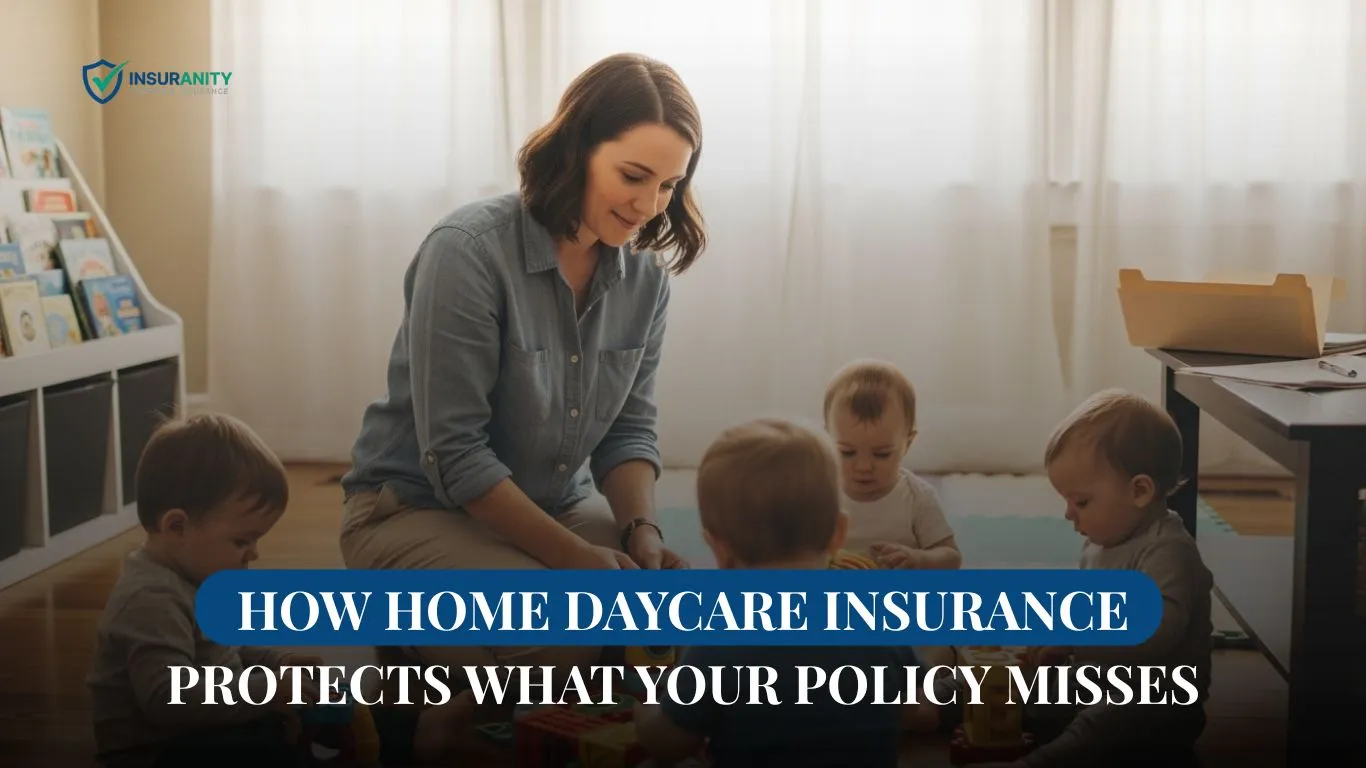
Imagine this: It’s a Wednesday morning. You’ve got four toddlers in your living room, snacks on the table, and a carefully planned activity ready to go. Then one child trips over a toy, hits their head on the coffee table, and the parents rush over within the hour. Everyone is okay, but the parents start asking about medical coverage. You reach for your homeowners’ insurance card. And that’s when the sick feeling hits. You’re not covered.
This is not a rare situation. Thousands of home daycare providers across the United States find themselves in exactly this spot every year. They assume their standard homeowners policy protects them. It doesn’t.
That is exactly why home daycare insurance exists, and exactly why understanding it matters before something goes wrong, not after.
What Is Home Daycare Insurance, and Why Does It Exist?
Home daycare insurance is a specialized type of business coverage designed specifically for people who run a childcare operation out of their own home. It is designed to cover the risks associated with caring for other people’s children in a residential setting.
Here is what most providers don’t realize: a standard homeowners policy typically covers your personal life, your belongings, your personal liability if a guest slips, and your property damage. The moment you start operating a business from that same home, most of those protections shrink dramatically or disappear entirely.
Most standard policies cap business-related property coverage at around $2,500 and exclude business liability coverage entirely for home-based commercial operations. That means if a child is hurt in your care and a lawsuit follows, your personal savings, your house, your car, everything you’ve built, could be on the line.
In-home daycare insurance fills that exact gap. It picks up where your homeowners’ policy stops.
The Silent Gap in Your Homeowners Policy
Let’s make this very simple. Think of your homeowners’ policy like an umbrella. It covers a certain area. The moment you start watching other people’s children for pay, part of that umbrella quietly folds up, and you don’t always know which part until it rains.
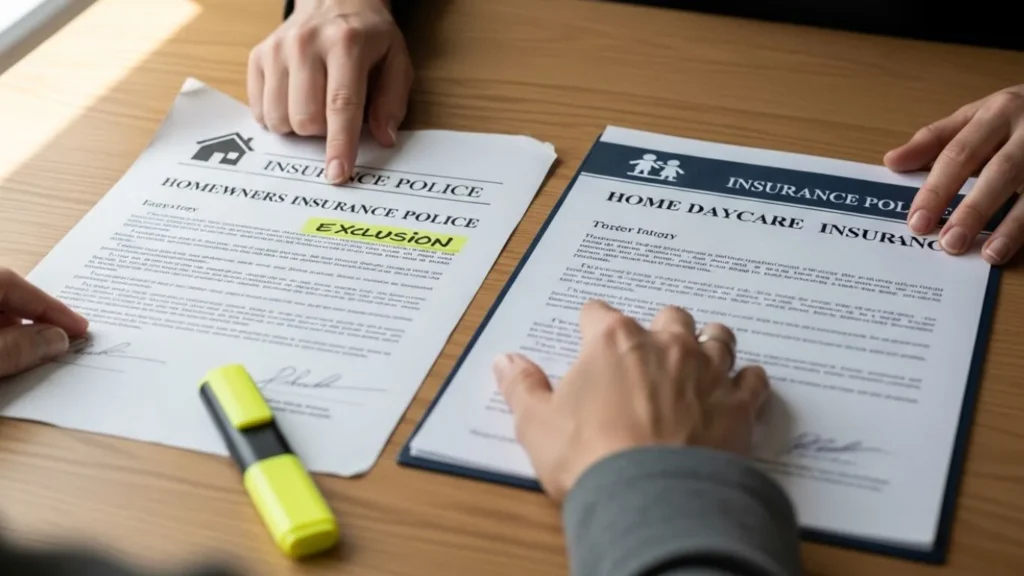
The three biggest gaps in a standard policy are:
1. Liability for childcare injuries
If a child in your care is hurt, they fall, choke, or have an allergic reaction, your personal liability coverage most likely won’t respond to that claim. It’s excluded as a business activity.
2. Business property damage
Your toys, play equipment, cribs, highchairs, and safety gates are business property. A standard homeowners policy won’t replace them if they’re destroyed in a fire or flood above that $2,500 limit.
3. Accusations and allegations
Even unfounded claims of abuse or neglect can result in legal defense costs. Without proper home daycare liability insurance, you pay those costs yourself.
This is the core reason insurance for home daycare was created as its own category, not as an add-on to life insurance or health insurance, but as purpose-built protection for small childcare businesses operating in residential spaces.
The 3 Types of Home Daycare Insurance Every Provider Needs
Understanding 3 types of home daycare insurance gives you the foundation to build the right coverage plan. Each one covers a different area of risk.
1. General Liability Insurance
This is often called “slip and fall” coverage. It is the backbone of home daycare liability insurance and the first policy every in-home provider should have.
General liability covers:
- Bodily injury to a child or parent on your property
- Property damage you accidentally cause to someone else’s belongings
- Legal defense costs if a lawsuit is filed against you
- Advertising injury (if you promote your business online and a claim arises)
Think of it as the three P’s: physical, personal, and property protection.
Most states require at least some level of liability insurance for in-home daycare as part of licensing. In Texas, for example, licensed family homes must carry a minimum of $300,000 in liability per incident. Requirements vary by state, which is why understanding in-home daycare insurance requirements is essential before you open your doors.
2. Professional Liability Insurance
Also called errors and omissions (E&O) insurance, this coverage protects you when a parent claims you did something wrong professionally or failed to do something you should have.
For a home daycare, this might look like:
- A child didn’t receive proper supervision and was injured
- A special needs child didn’t receive accommodated care
- A parent claims their child’s developmental delays were worsened by your environment
This is a type of coverage that competitors like Brightwheel and Policygenius mention briefly, but don’t fully explain in terms of when it activates. Professional liability is different from general liability because it covers decisions and judgment, not just physical accidents.
Liability insurance for home daycare that includes a professional component is especially important if you care for children with special medical needs or behavioral conditions.
3. Business Property Coverage
Your business runs on equipment: cribs, changing tables, car seats, learning toys, safety gates, baby monitors, and outdoor play structures. All of it costs money. None of it is covered under your standard homeowners policy once it crosses the threshold of “business use.”
Daycare home insurance packages that include business property coverage will replace or repair that equipment if it’s damaged, stolen, or destroyed. Some policies also cover loss of income if your home becomes temporarily uninhabitable due to a covered event.
What Does Home Daycare Insurance Cost?
One of the most searched questions in this space is home daycare insurance cost, and for good reason. Providers want to know if they can afford proper coverage before they commit.

The honest answer: it depends on several factors. But here is a general benchmark table to give you a real-world starting point.
| Coverage Type | Estimated Monthly Cost | Annual Estimate |
|---|---|---|
| General Liability (solo provider) | $25 – $55/month | $300 – $660/year |
| General Liability + Professional Liability | $45 – $90/month | $540 – $1,080/year |
| Full Package (GL + PL + Property) | $75 – $150/month | $900 – $1,800/year |
| Homeowners Endorsement (add-on only) | $15 – $40/month | $180 – $480/year |
In-home daycare insurance cost is influenced by:
- Number of children in your care
- Your state and local regulations
- Whether you have any employees or assistants
- Your claims history
- Your business experience and years of operation
In-home daycare insurance cost in high-cost states like California tend to run higher than national averages due to state-specific liability requirements and licensing mandates. We’ll look at that in a moment.
It’s also worth noting that a homeowner’s endorsement, while the cheapest option, is usually not sufficient for full-time providers. It often caps liability at lower limits and excludes professional liability entirely. Understanding the true in-home daycare insurance cost means looking beyond the monthly premium and thinking about what you’d actually need if a claim were to hit.
Home Daycare Insurance in California: What You Need to Know
Home daycare insurance California rules are more involved than most states. California has two licensed childcare categories for home-based providers:
- Family Child Care Home (Small): Up to 8 children
- Family Child Care Home (Large): 9 to 14 children
California’s Community Care Licensing Division (CCLD) requires licensed providers to carry liability insurance as a condition of their license. Minimum coverage amounts are set by the state, and they are higher than those required by many other states.
If you’re operating in California, insurance for in-home daycare should include:
- At a minimum of $300,000 general liability per occurrence
- Professional liability coverage
- Non-owned auto coverage if you transport children
California also enforces stricter inspection and documentation standards, which means your policy may be reviewed during licensing renewals. Working with an insurance advisor familiar with California childcare regulations is strongly recommended.
In-Home Daycare Insurance Requirements by State
While every state has its own rules, here is what the general landscape of in-home daycare insurance requirements looks like across the US:
Most states fall into one of three categories:
Mandatory
States that require liability coverage as part of the childcare licensing process. California, Texas, New York, and Florida all fall here.
Recommended but Not Required
States where licensing is possible without insurance, but where advisors strongly recommend it due to the financial risk involved.
Requirement Depends on Size
Some states only require insurance if you care for more than a certain number of unrelated children, often more than three or six.
To understand the specific in-home daycare insurance requirements in your state, the best resource is your state’s Department of Health and Human Services or Child Care Licensing Agency. Insuranity’s resource guides are also being expanded to cover state-by-state breakdowns.
As a home provider, it’s your responsibility to know these rules. Not knowing them doesn’t protect you from the consequences of operating without proper coverage. If you’re also exploring coverage for other aspects of your business or personal situation, understanding what a health insurance premium means can help you think through your full financial protection plan.
What Kind of Insurance Does a Home Daycare Need? A Step-by-Step Guide
If you’re just getting started or evaluating your current coverage, here is a simple process to follow.

Step 1: Know your state’s licensing requirements
Before anything else, look up your state’s childcare licensing rules. Some states require proof of liability insurance for home daycare before issuing a license at all.
Step 2: Count how many children you care for
The number of children affects both your coverage needs and your premium costs. If you care for more than six children, you may need a commercial daycare policy instead of a home-based one.
Step 3: Decide whether you need employees
If you have an assistant, you’ll likely need workers’ compensation coverage in addition to your standard home daycare insurance package.
Step 4: Assess your property
List all the equipment you use for childcare, play structures, safety equipment, furniture, and learning materials. This helps you determine how much business property coverage you need.
Step 5: Get multiple quotes
Don’t accept the first offer. Compare quotes from at least three providers who specialize in insurance for home daycare rather than general business insurance. Specialist insurers understand the unique risks of childcare better than general commercial insurers.
Step 6: Read your policy carefully
Specifically, look for exclusions. Know what isn’t covered. Ask whether abuse and molestation liability is included. Many base policies exclude it, but it can be added as an endorsement.
Step 7: Review annually
Your business changes. The number of children, your staff, your equipment, and your state’s requirements, all of these can shift from year to year. Review your in-home daycare insurance policy every twelve months and update it accordingly.
How to Think About Coverage Like a Business Owner
Here is the mindset shift that changes everything: You are not just a caregiver. You are a business owner.
The moment you accepted your first payment for watching a child, you entered the world of small business ownership. That means your personal homeowners policy is no longer enough. It was designed for a person, not a business.
Running a home daycare without proper business property coverage is like driving without a seatbelt. Most days nothing happens, but when something does, the consequences are severe and often irreversible.
Home daycare insurance is not a luxury. It is the financial foundation that makes your business real, credible, and sustainable. It tells parents you take their children’s safety and their trust seriously. And it protects everything you’ve worked to build from one bad afternoon that was never your fault.
A Quick Word on Homeowners Endorsements
Some insurance companies offer what’s called a homeowners insurance endorsement or rider, essentially a small extension of your current homeowners policy to include limited childcare coverage. This might seem like the easiest and cheapest path.
It can work, but only in specific situations. If you care for a very small number of children part-time and your state’s in-home daycare insurance requirements allow it, an endorsement might meet your minimum needs. But for most full-time providers, a standalone in home daycare insurance policy is the only way to be properly covered.
An endorsement typically offers no professional liability, lower liability limits, and no abuse and molestation coverage. These are exactly the risks that home daycare operators face most often.
FAQs
Can a parent sue me personally even if I have home daycare insurance?
Yes, a parent can still name you personally in a lawsuit even when you have in-home daycare insurance. However, that is exactly what your policy is designed to handle. Your general liability coverage pays for your legal defense costs and any covered judgments against you, up to your policy limits. Without coverage, those costs come directly out of your personal savings and assets. One important note: if a claim exceeds your policy limit, you may still be personally responsible for the difference, which is why some providers add an umbrella policy on top of their base home daycare liability insurance for extra protection.
Does home daycare insurance cover allegations of abuse or misconduct, even if the claim is false?
Many base home daycare insurance policies do not automatically include abuse and molestation coverage. It is often sold as a separate endorsement or add-on. Even a completely false allegation of misconduct can result in thousands of dollars in legal defense costs. Some states, including Arizona, actually require this coverage as part of the licensing process. Before you sign any policy, confirm in writing whether abuse and molestation liability is included or excluded, and what the coverage limit is.
What happens to my home daycare insurance if I hire an assistant or employee?
The moment you bring on a paid employee or assistant, your coverage needs change significantly. A standard in home daycare insurance policy or homeowners endorsement is typically written for a sole proprietor only. Once you have employees, you will likely need workers' compensation insurance in most states, and your general liability policy may need to be upgraded to a commercial-level policy to properly cover employee-related incidents. Failing to update your coverage after hiring someone can result in denied claims or even policy cancellation if an incident occurs and your insurer discovers you had undisclosed employees.
How does home daycare insurance affect my homeowners insurance policy — can having it cause my homeowners premium to go up or my policy to be canceled?
Some insurers may cancel or non-renew your homeowners policy if they discover you are operating a business from your home without notifying them. Properly disclosing your daycare home insurance needs to your homeowners carrier — and adding the right endorsement or separate policy — protects both your business and your personal home coverage. The two policies need to work together, not against each other. Always inform both carriers about your situation to make sure there are no gaps or conflicts between your personal and business coverage.
The Bottom Line on Home Daycare Insurance
Your homeowners’ policy has a gap. It was never designed to cover a business. Home daycare insurance exists specifically to fill that gap, protecting you, the children in your care, and everything you’ve built from the financial consequences of accidents, allegations, and lawsuits.
Understanding what kind of insurance does a home daycare need is the first step. Taking action before something goes wrong is the second.
Whether you’re in California navigating strict licensing rules, in Texas meeting minimum liability thresholds, or anywhere else in the US building a childcare business from your home, proper in home daycare liability insurance is not optional. It is the foundation your business stands on.
Explore more insurance guides and education at Insuranity, built for real people who want to understand their coverage without the confusing insurance jargon.
Disclaimer: Insuranity is an educational resource. We do not sell insurance policies directly. Always consult a licensed insurance professional for personalized coverage advice.