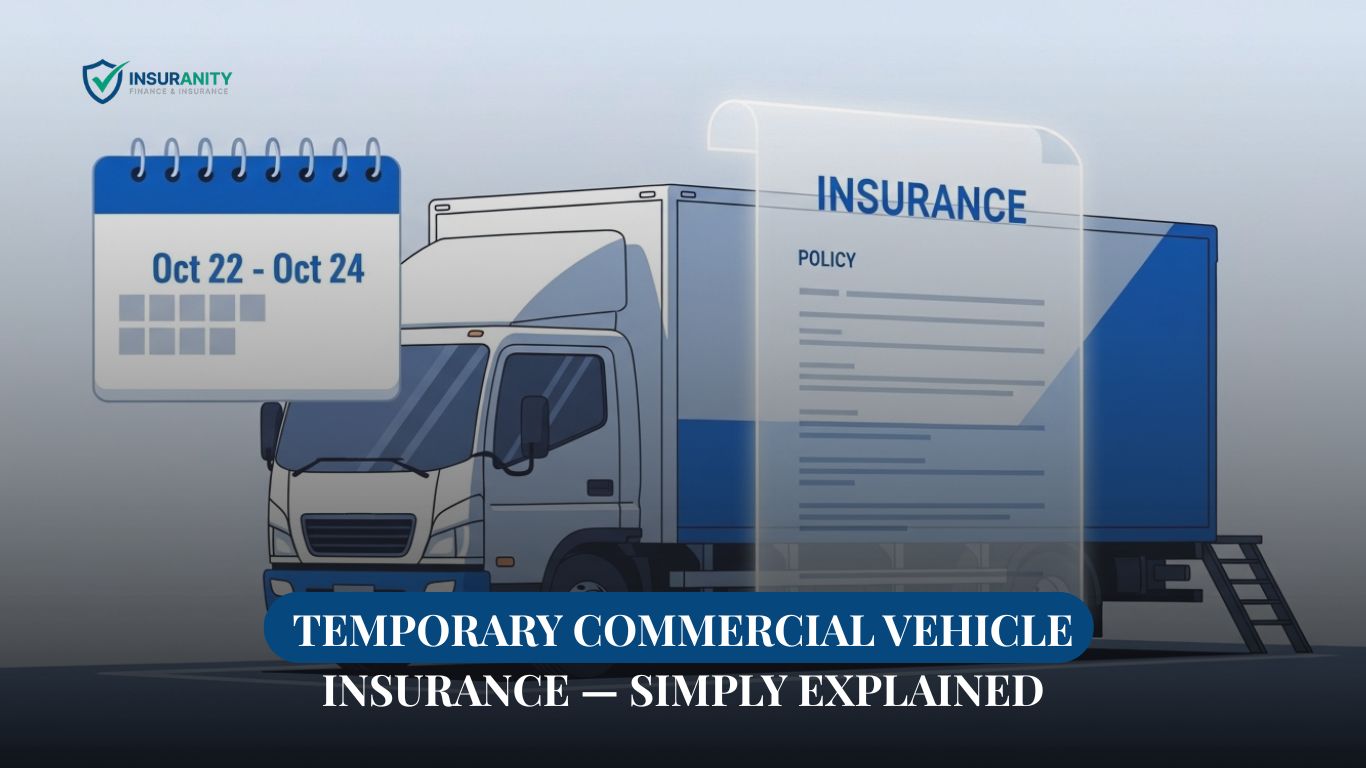
Imagine this: You just bought a used box truck for your small delivery business. The deal closes on a Friday afternoon. Your regular annual policy does not start until Monday. The truck is sitting in a lot two hours away, and you need to move it home over the weekend. What do you do?
This is exactly the kind of situation millions of small business owners and independent drivers face every year, and most of them have no idea that a solution even exists. That solution is called Temporary Commercial Vehicle Insurance, and once you understand how it works, it feels less like a complicated insurance product and more like a safety net that just makes sense.
What Exactly Is Temporary Commercial Vehicle Insurance?
In plain terms, Temporary Commercial Vehicle Insurance is a short-term policy that covers a truck, van, or any vehicle used for business purposes for a limited period of time. Instead of locking you into a six-month or twelve-month contract, this type of coverage can last anywhere from a single day to about thirty days, depending on what you need and who provides it.
Think of it like a prepaid phone plan. You only pay for the days you actually need. When those days are up, the coverage ends. Simple.
This is different from your standard annual commercial auto policy, which is designed for vehicles that are on the road constantly throughout the year. Temporary Commercial Vehicle Insurance fills the gaps, the short windows of time when a vehicle is being used for business, but long-term coverage either has not started yet or simply does not make financial sense.
It is worth noting that almost every state in the US legally requires commercial vehicles to be insured whenever they are being driven, even temporarily. So this is not just a smart financial move. In most cases, it is a legal requirement.
Who Actually Needs This Type of Coverage?

This is where things get interesting, because the answer is broader than most people think. Here are the most common situations where short-term commercial auto coverage becomes essential:
Owner-operators buying or relocating a truck
You purchased a commercial vehicle and need to drive it home or to a yard before your main policy activates. Without coverage, that drive is technically illegal in most states and financially risky.
Seasonal businesses
Agricultural transporters, Christmas tree delivery companies, or summer landscapers may only operate their commercial vehicles for a few months per year. Paying for a full twelve-month policy when the truck sits idle for eight months is simply wasted money.
Businesses testing a new route or service
If you are not sure whether a new delivery route will be profitable, committing to an annual policy makes little sense. A short-term commercial auto coverage policy lets you test the waters first.
Vehicles being borrowed or rented temporarily
If a company adds a truck to its fleet for a week because of a large job, short-term coverage handles it cleanly.
Vehicles undergoing testing or ferry drives
Moving a truck from a dealership to a repair shop, or from one location to another, is a classic use case for a one-to-five-day policy.
Understanding why you need it also helps you avoid paying for something you do not actually need, which brings us to what this coverage actually includes.
What Does It Cover?
Just because a policy is temporary does not mean it is weak. A solid Temporary Commercial Vehicle Insurance plan typically includes the following protections:
Liability coverage
Is the foundation and, in most states, is legally required. This pays for injuries or property damage you cause to other people in an accident. If your truck clips another car at a loading dock, liability coverage steps in.
Physical damage coverage
Protects the vehicle itself. This includes collision coverage, for damage from hitting another vehicle or object, and comprehensive coverage, which handles theft, weather damage, and other non-collision incidents.
Non-trucking liability
(sometimes called bobtail insurance) covers you when the truck is being driven for non-business purposes, such as driving home after dropping off a load.
Uninsured motorist coverage
protects you when the other driver in an accident does not have enough insurance of their own.
One thing to keep in mind: most short-term commercial policies do not cover cargo, tools, or equipment inside the vehicle. They also typically do not apply to hazardous materials hauling. Always read what is specifically excluded before you sign anything.
If you are also thinking about broader protection for your business vehicles, it helps to understand how vehicle insurance works across different coverage types so you can spot gaps before they become problems.
Temporary Commercial Vehicle Insurance policies
Here is what is commonly excluded from Temporary Commercial Vehicle Insurance policies:
- Cargo and freight. If you are hauling goods and something happens to them, a standard short-term policy will not pay for the cargo.
- Pre-existing vehicle damage. Any damage that existed before the policy started is not covered.
- Intentional acts. No legitimate policy covers damage you caused on purpose.
- Hazardous materials. Transporting chemicals, fuel, or other regulated substances usually requires a specialized policy.
- Non-business personal use. If the vehicle is used for a personal errand while under a commercial-only temporary policy, some claims may be denied.
Knowing these exclusions ahead of time means you are not blindsided when you file a claim.
How Much Does It Cost?
Pricing for Temporary Commercial Vehicle Insurance varies based on several factors, but here is a general picture to help you plan:
| Factor | Impact on Price |
|---|---|
| Type of vehicle (pickup vs. semi-truck) | Higher vehicle value = higher premium |
| Duration of coverage (1 day vs. 30 days) | Longer periods cost more total, but often less per day |
| Driver’s record and CDL status | Clean records lower your rate |
| State and business location | Some states have higher minimum requirements |
| Type of use (ferry drive vs. hauling) | Hauling loads typically costs more |
| Coverage limits selected | Higher limits increase the premium |
As a rough benchmark, short-term commercial truck insurance can cost anywhere from about $35 to $150 or more per day for basic liability coverage, depending on the vehicle and use case. Specialty insurers like National Independent Truckers Insurance Company (NITIC) offer one to five-day policies, though these typically carry lower liability limits of around $60,000. Classic Truck Insurance offers thirty-day policies with $1 million in non-trucking liability, which is a much stronger protection level.
It is also worth noting that short-term policies tend to cost more per day than long-term annual policies. You are paying a premium for flexibility. That said, if you genuinely only need coverage for three days, spending $120 is far smarter than locking into a six-month contract worth thousands.
For context, the average small business pays around $147 per month for a standard commercial auto insurance policy. If you do the math, that is about $4.90 per day. Temporary policies cost more per day, but they exist precisely for situations where an annual commitment makes no sense.
Step-by-Step: How to Get Temporary Commercial Vehicle Insurance
Getting short-term coverage is simpler than most people expect. Here is how to do it without wasting time or money:

Step 1: Know exactly what you need before you call anyone
Write down the vehicle’s make, model, year, and VIN. Know how many days you need coverage and what the vehicle will be used for during that time. Having this ready cuts the process in half.
Step 2: Check if your current insurer offers short-term options
Some carriers allow you to temporarily extend an existing policy for a fee. This is often the fastest route if you already have a commercial policy in place.
Step 3: Contact an independent insurance broker
Most major national insurers do not offer short-term commercial policies. Independent brokers have access to specialty insurers who do. This step is especially important if you need coverage quickly.
Step 4: Compare at least two or three quotes
Even for a short policy, rates vary significantly between providers. A broker can pull multiple options at once, saving you time.
Step 5: Confirm coverage meets your state’s minimum requirements
Every state sets its own floor for commercial vehicle liability. Make sure the policy you choose clears that bar before you accept it.
Step 6: Bind the policy and get proof of insurance in writing
Most specialty insurers can bind a short-term policy within fifteen to thirty minutes. You should receive a certificate of insurance (COI) that you can carry in the vehicle.
Step 7: Review what happens at expiration
Some policies renew automatically. Some do not. Understand exactly when your coverage ends so you are not driving uninsured without realizing it.
This process is also a great reminder that understanding the basics of how commercial vehicle policies are structured helps you ask better questions when talking to a broker.
Short-Term vs. Long-Term: A Direct Comparison
| Temporary Commercial Vehicle Insurance | Standard Annual Policy | |
|---|---|---|
| Duration | 1 day to 30 days | 6 to 12 months |
| Cost per day | Higher | Lower |
| Flexibility | Very high | Low |
| Cargo coverage | Usually not included | Often available as add-on |
| Availability | Specialty insurers only | Most major carriers |
| Best for | One-off jobs, ferry drives, seasonal gaps | Regular business vehicle use |
Real-World Scenarios That Make This Make Sense
The harvest hauler
A small farm in the Midwest uses a flatbed truck to transport produce for six weeks during harvest season. Buying a full annual policy for six weeks of use makes no financial sense. A thirty-day short-term commercial auto coverage policy fits perfectly and keeps them legally compliant.
The new owner-operator
David just became an independent trucker and purchased his first rig on a Tuesday. His motor carrier authority will not be active for another week. He needs to move the truck to his yard on Wednesday. A two-day temporary policy covers that window cleanly.
The contractor with a rented truck
A construction company rents an additional cargo van for two weeks to handle a large project. Rather than adding it to their annual fleet policy and going through underwriting delays, a short-term policy bridges the gap instantly.
These real-world examples also show why understanding insurance basics, like what triggers a claim or how liability limits work, saves you money in the long run. At Insuranity, we cover topics like health insurance decisions and life insurance value with the same plain-English approach, because the goal is always the same: help you make a smart decision without needing a law degree to understand it.
Where to Find Short-Term Commercial Vehicle Policies
Most national insurance brands, such as Progressive, State Farm, or Allstate, do not sell short-term commercial vehicle policies directly online. However, that does not mean you are out of options. Here is where to look:
Specialty commercial trucking insurers
like NITIC (National Independent Truckers Insurance Company) and Classic Truck Insurance focus specifically on short-duration commercial coverage.
Independent insurance brokers
Are you the best resource? They work with multiple specialty carriers and can find coverage for unusual situations that a standard agent might turn away.
Online specialty platform
Emerging products that allow business owners to bind short-term commercial coverage in minutes, similar to how consumer apps work for personal auto. This is a growing space driven by demand for flexibility.
It is also worth knowing that the commercial trucking insurance market has seen rate increases for over twenty consecutive quarters as of early 2026, driven by higher repair costs, more litigation, and supply chain pressures on vehicle parts. This makes shopping around even more important right now.
Common Mistakes to Avoid
Even well-informed business owners make these errors. Knowing them ahead of time keeps you out of trouble:

Assuming your personal auto policy covers business use
It rarely does. Personal policies typically exclude commercial activity, and claims filed under the wrong policy will be denied.
Underestimating the duration you need
If your coverage expires a day before you complete a job, you are driving uninsured. Always add a buffer day when in doubt.
Choosing the cheapest policy without checking the liability limits
A $60,000 liability limit sounds like a lot until you are involved in a serious accident. Medical bills and legal costs can climb far higher than that very quickly.
Not reading the exclusions
Every short-term policy has them. The ones around cargo, hazardous materials, and intentional acts are the most important to understand before you drive a single mile.
Canceling too early and triggering a minimum earned premium clause
Some insurers keep a portion of your premium even if you cancel the policy early. Check for this before you commit.
FAQs
Will a bad driving record or recent violations stop me from getting short-term commercial vehicle coverage?
Not necessarily, but it will affect your options and your price. Minor violations, a couple of speeding tickets or a single at-fault accident, typically raise the premium but do not disqualify you. However, serious violations such as a recent DUI or DWI, reckless driving, or multiple at-fault accidents within three years can make it very difficult to find short-term coverage. If you have an SR-22 or FR-44 requirement on file, you must disclose it upfront to any broker or insurer. Misrepresenting your driving record on a short-term application is treated as fraud and can result in a denied claim, policy cancellation, and potential damage to your CDL status. The honest approach is always the right one here. A good independent broker can still find options even for difficult driving histories.
Can I extend my temporary commercial vehicle policy if my plans change and I need more time?
Sometimes yes, but it is not guaranteed. Some specialty insurers will allow a one-time extension if you contact them before the current policy expires. Others will not extend the same policy at all and instead require you to purchase a brand new short-term policy for the additional days needed. There is also an important catch: if your situation changes, for example, you started as a simple ferry drive but now plan to haul cargo or operate commercially, most short-term policies will not cover the new use, even with an extension. You would need a different type of policy altogether. The key rule is to always contact your broker before the coverage end date and never assume the policy auto-renews.
Does temporary commercial vehicle insurance affect my CDL status if I file a claim?
Not directly, but the circumstances behind the claim can. Filing a claim itself does not put your CDL at risk. However, if the incident that led to the claim involves a serious traffic violation, such as reckless driving, excessive speeding, or driving under the influence, those violations can trigger CDL consequences under federal and state law, regardless of what type of insurance policy was in place at the time. What short-term coverage does do is keep you legally compliant and on the road during gap periods. Driving a commercial vehicle without any insurance is itself a violation in most states, and getting caught can result in fines, points on your record, and in some cases, suspension of commercial driving privileges. So while the insurance does not protect your CDL directly, having it prevents the legal exposure that comes from driving uninsured.
Is there a difference between temporary commercial vehicle insurance and non-trucking liability (bobtail) insurance?
Yes, and mixing them up is a common and costly mistake. Temporary commercial vehicle insurance is a short-duration policy that provides primary liability and often physical damage coverage for a vehicle being driven during a specific window of days. It is typically used when no other policy is in place at all. Non-trucking liability insurance, also called bobtail insurance, is designed for owner-operators who are already under a motor carrier's policy while under dispatch, but need personal coverage for the times they are driving the truck for non-business reasons, such as driving home after a delivery. Bobtail coverage is not a standalone temporary policy. It is a supplement to an existing motor carrier policy. If you do not have a motor carrier policy in place, bobtail insurance is not the right product for your situation. Short-term commercial vehicle coverage is the correct starting point.
Is Temporary Commercial Vehicle Insurance Right for You?
Here is a simple way to think about it. If you need a commercial vehicle covered for fewer than thirty days, and an annual policy would mean paying for months you will never use, then short-term coverage is almost certainly the smarter financial choice.
If you are driving a commercial vehicle regularly throughout the year, a standard annual policy will almost always be cheaper per day and offer more comprehensive protection.
The key is matching the policy to the actual situation rather than defaulting to whatever is easiest to find. That principle, matching coverage to your real needs, is something we apply to every insurance topic we cover here at Insuranity.
Temporary Commercial Vehicle Insurance is not a workaround or a second-rate option. It is a legitimate, well-established product that exists because the real world does not always operate on annual cycles. Trucks get bought on Fridays. Seasonal work does not last twelve months. New routes need testing. Short-term coverage simply meets those realities head-on.
When you understand it clearly, it is not complicated at all. It is just the right tool for the right situation.
Disclaimer: The content published on Insuranity is intended for informational and educational purposes only. It does not constitute legal, financial, or professional insurance advice. Insurance policies, coverage terms, legal requirements, and pricing vary by state, insurer, and individual circumstances. Always consult a licensed insurance professional or broker before making any coverage decisions. Insuranity is not a licensed insurance agency and does not sell or underwrite insurance products.